Lotus Endometriosis Institute solid color logo

Laparoscopy

Related Posts

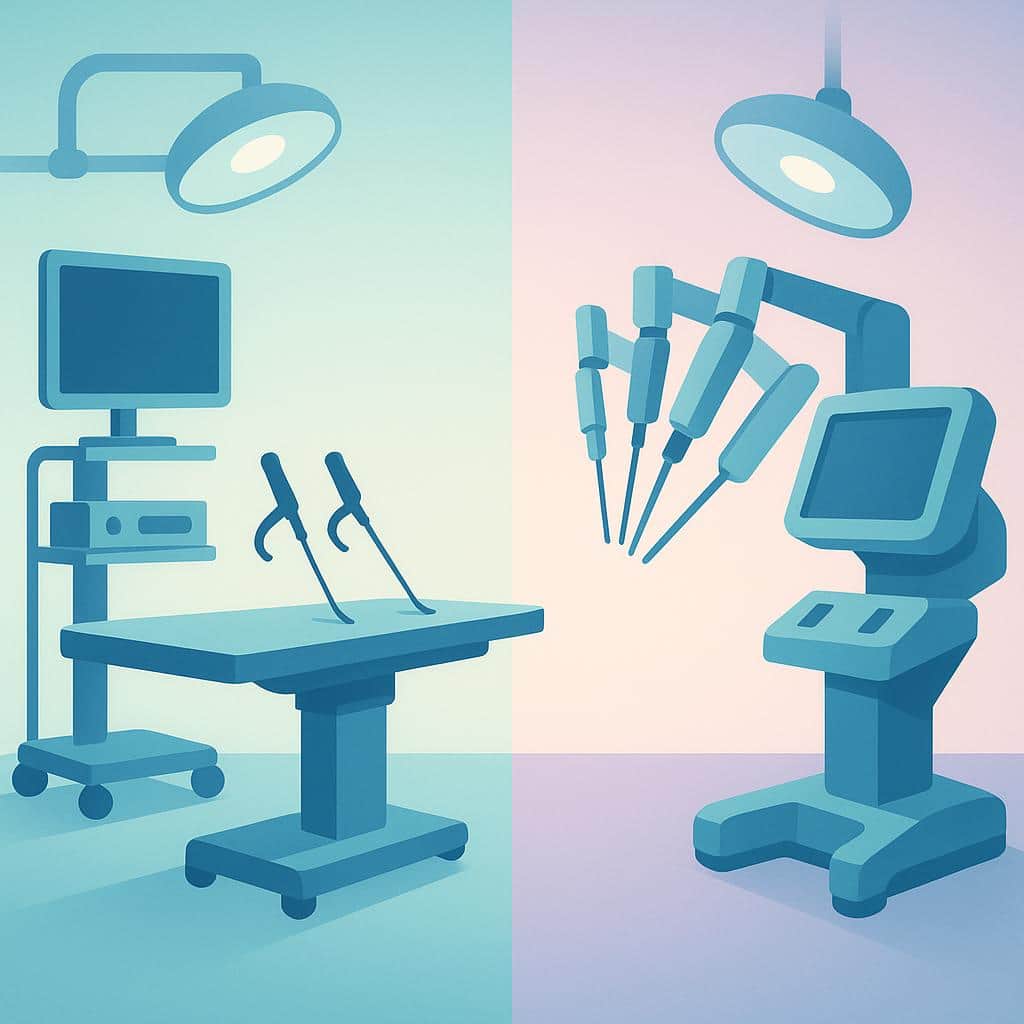
Clear, evidence-based guidance on minimally invasive surgery for endometriosis—excision vs ablation and robotic vs conventional—covering indications, risks, outcomes, and recovery to help you choose the right approach with your care team.

Overview

Laparoscopy is the standard minimally invasive surgery used to diagnose and treat endometriosis through a few small incisions and a high‑definition camera. It allows surgeons to map lesions, free adhesions, and restore pelvic anatomy, often improving pain and fertility. Decisions to operate are individualized based on symptoms, failed conservative care, fertility goals, and imaging; high‑quality ultrasound or MRI can help plan the procedure and team, especially for deep disease. See related guidance in Diagnostics & Imaging and Imaging for Surgery.


During laparoscopy, surgeons may remove disease by excision or ablate superficial lesions; the choice depends on lesion depth, location, and your priorities. For durable pain relief and complex or deep disease, evidence generally favors excision; superficial disease may be ablated in selected cases. Robotic versus conventional approaches mainly reflect surgeon preference and case complexity, with outcomes driven by expertise. Laparoscopy does not diagnose adenomyosis, though laparoscopic hysterectomy or uterus‑sparing procedures may address it; see Adenomyosis and Surgical Options. Expect outpatient surgery and a graded recovery with specific guidance in Postoperative Recovery.

Common Questions

What is the AAGL endometriosis classification system?

The AAGL endometriosis classification system is a standardized way surgeons describe what they found at surgery—where endometriosis is located, how extensive it is, and how complex the disease appears. Its goal is to create a more consistent “shared language” than older staging alone, especially for cases where symptoms and imaging don’t tell the full story.


Unlike simple stage labels, AAGL-style classification is meant to better capture real-world surgical complexity, including deeper disease that can involve structures like the uterosacral ligaments, rectovaginal space, bowel, bladder, or ureters. This matters because location and depth (for example, deep infiltrating disease) can drive very different symptoms and may change imaging choices and surgical planning. If you’re reading an operative report or trying to make sense of what a surgeon told you, our team can help translate the classification into what it likely means for your body, your symptoms, and the treatment path you’re considering.

Read full answer

Is endometriosis surgery only for fertility?

No—endometriosis surgery is not only for fertility. Excision surgery is often performed primarily to relieve pain and other symptoms, to restore normal anatomy when disease has scarred or “frozen” the pelvis, and to address endometriosis affecting organs like the bowel, bladder, ureters, or diaphragm. Surgery can also be the most definitive way to confirm the diagnosis, because endometriosis isn’t always visible on imaging.


Fertility can be an important goal, but it’s just one possible indication—and it’s not always the reason to operate. For example, removing an ovarian endometrioma before IVF is no longer considered “routine” unless there’s a clear reason such as severe pain, concerning imaging features, or a practical barrier to safe egg retrieval. In our practice, we focus on tailoring excision to what problem we’re trying to solve in your body—symptom relief, organ safety/function, diagnosis, fertility goals, or a combination—so you can make a decision that fits your timeline and priorities. If you’re unsure whether surgery makes sense in your situation, you can reach out to schedule a consultation with our team to review your symptoms, imaging, and goals and map out an individualized plan.

Read full answer

Does endometriosis stage predict pain severity?

Not reliably. The ASRM stages (I–IV) mainly describe what’s seen at surgery—location, amount of disease, scarring, and adhesions—not how your nervous system experiences pain. That’s why someone can have “low-stage” endometriosis with debilitating symptoms, while another person with more extensive disease reports surprisingly little pain.


Pain tends to correlate more with where lesions are, whether deeper structures are involved (like bowel, bladder, ureters, or pelvic nerves), and how much inflammation, pelvic floor guarding, and pain sensitization have developed over time. In our practice, we focus less on the stage number and more on your specific symptom pattern (period pain, pain with sex, bowel/bladder symptoms, cyclical flares, leg or diaphragmatic pain), paired with expert imaging when appropriate, to understand what’s driving your pain.


If you’ve been told your pain “shouldn’t be that bad” because of a stage label, you’re not alone—and you’re not imagining it. Exploring endometriosis subtypes, coexisting conditions (like adenomyosis), and pain mechanisms often explains the mismatch and opens the door to more targeted treatment options, including excision when indicated. If you’d like, you can reach out to schedule a consultation so our team can review your history and help map symptoms to likely sources.


Read full answer

Why was more endometriosis found in surgery than on imaging?

It’s very common for surgery to reveal more endometriosis than ultrasound or MRI suggested. Imaging is best viewed as a tool to estimate likelihood and to map certain higher-risk areas for surgical planning—not a reliable “yes/no” detector for every lesion. Many endometriosis lesions are simply hard to visualize on scans because they can be small, superficial, hidden by normal anatomy, or located in areas where imaging performance varies (and where interpretation depends heavily on technique and experience).


Another reason is that scans are better at identifying some patterns—like ovarian endometriomas or certain deep bowel disease—than they are at detecting disease on ligaments, the bladder/anterior compartment, or in complex multi-compartment cases. Imaging also can’t always capture the full extent of adhesions, scar-like tissue, or subtle inflammatory changes that may become obvious only when the pelvis is directly inspected during laparoscopy.


When we plan surgery, we use imaging as one piece of the puzzle alongside your symptom story, exam findings, and overall pattern—because the goal is safe, complete mapping and excision when appropriate. If your operative findings didn’t “match” your scan, it doesn’t mean the imaging was pointless or that your symptoms were exaggerated—it usually reflects the known limits of what scans can show. If you’re trying to make sense of your results or next steps, our team can help you review what was found, what was removed, and what else (like adenomyosis or coexisting pain drivers) may still need to be addressed.

Read full answer

What do endometriosis stages mean?

Endometriosis “staging” is a surgical scoring system (most often the ASRM system) that describes what was found at laparoscopy—things like how much disease is present, where it is, and whether there are adhesions or ovarian endometriomas. It sorts findings into four stages (I–IV), from minimal to severe, based on those anatomic features. This can be helpful shorthand for documentation and planning, but it’s not a complete picture of the disease.


The most important thing to know is that stage does not reliably predict how much pain you have, how disabling your symptoms are, or even how complex your case may be. Someone can have intense symptoms with a low stage score, while another person with a higher stage may have less pain. That’s because symptoms often depend on where endometriosis is and how it behaves—especially with subtypes like deep infiltrating disease (which can involve structures such as the bowel, bladder, ureters, and pelvic ligaments) that aren’t always captured well by a single staging number.


In our practice, we look beyond stage and focus on mapping disease location, identifying subtypes, and understanding your full symptom pattern and goals (pain relief, fertility, organ function, recurrence risk). If you’ve been told a stage and it doesn’t seem to “match” what you’re experiencing, that doesn’t mean your symptoms are any less real—it usually means the staging label is incomplete. You can explore our educational resources or reach out to schedule a consultation so our team can help interpret what your stage means in the context of your specific anatomy and symptoms.

Read full answer

Can scar tissue look like endometriosis on ultrasound or MRI?

Yes. Scar tissue (adhesions or postoperative scarring) can sometimes resemble endometriosis on imaging, and endometriosis itself can also create fibrosis that looks “scar-like.” Ultrasound and MRI can be very helpful when they’re expertly performed and interpreted, but the findings can still land in a gray zone—especially when inflammation, prior surgery, or distorted anatomy is involved.


This is also why we don’t diagnose (or rule out) endometriosis based on imaging alone. Our approach is to pair imaging with your full symptom story, flare pattern, and exam findings, and to actively consider look-alike or coexisting conditions (like adenomyosis, pelvic floor dysfunction, hernias, or vascular causes) that can mimic endometriosis pain.


When the distinction truly matters for your treatment plan, the most definitive answer usually comes from surgery with histopathology of excised tissue. If you’ve been told imaging “looks like endo” (or “just scar tissue”) but your symptoms don’t add up, reach out—our team can help you sort out what’s most likely and what next steps make sense.

Read full answer

What does endometriosis show on a pathology report?

On a pathology report, endometriosis is typically described as endometrial-type glands and stroma found outside the uterus. Pathologists may also note supportive findings such as old or recent bleeding and iron-laden (hemosiderin) macrophages, which are signs the tissue has been hormonally active and bleeding over time. The report often lists the site the tissue came from (for example, pelvic peritoneum, ovary, bowel surface, bladder peritoneum) and may comment on the pattern, such as superficial implants, deeper fibrotic/nodular disease, or an ovarian endometrioma.


It’s also common for pathology to come back as “no endometriosis identified” even when symptoms are very real—or even when lesions looked suspicious in surgery—because confirmation depends on getting the right tissue from the right spot. Endometriosis can be subtle, patchy, or sit beneath a normal-looking surface, so sampling technique and lesion location matter. If you have a report you’re trying to decode, our team can help you understand what the wording means in the context of what was seen during surgery and what it suggests about next steps.

Read full answer

Can endometriosis be confirmed by biopsy without surgery?

In most cases, a biopsy that confirms endometriosis requires a procedure to actually reach and sample the suspected lesion—so “biopsy without surgery” is usually not possible for typical pelvic endometriosis. Endometriosis is confirmed when a pathologist sees endometrial-type glands and stroma (sometimes with bleeding-related changes) in the tissue sample, but the challenge is obtaining the right tissue from the right spot.


Even during surgery, biopsy results can be negative if the sample misses a tiny focus of disease, if endometriosis is hiding beneath a normal-looking surface, or if it’s located deeper (for example within bowel wall) where superficial sampling won’t capture it. That’s why visual appearance alone can be misleading, and why surgeon experience and sampling technique matter.


If you’re trying to avoid surgery, our team can still build a strong working diagnosis using your symptom pattern, exam, and expertly interpreted imaging, while also looking for conditions that mimic or amplify endometriosis pain. When you’re ready, we can walk you through when surgical evaluation with excision and pathology is most helpful—and how we use the tissue information to tailor longer-term planning.

Read full answer

Reach Out

Have a question?

Dr. Steven Vasilev delivers best-in-class endometriosis guidance and a personalized treatment plan—built on evidence and your unique biology.


Led by Steven Vasilev, MD—an internationally recognized endometriosis specialist & MIGS surgeon—Lotus Endometriosis Institute is virtual-forward, with many patients traveling nationally for care. Clinical evaluation and surgical treatment are provided in California.

Santa Monica, CA

2121 Santa Monica Blvd, Santa Monica, CA 90404

Operating Hours

8:00 am - 5:00 pm
Monday - Friday

Arroyo Grande, CA

154 Traffic Way, Arroyo Grande, CA 93420