


Infertility
Infertility can be the first noticeable sign of endometriosis or adenomyosis—especially when you feel otherwise “fine,” yet pregnancy isn’t happening. Both conditions can affect the pelvis in ways that disrupt ovulation, fertilization, implantation, and early pregnancy.
Overview
Difficulty getting pregnant is, for some people, the first sign that endometriosis or adenomyosis may be involved—arriving before any other symptom raises suspicion. While the clinical threshold is typically 12 months of trying (or 6 months for those 35 and older), many people seek answers sooner, especially when other risk factors are already on their radar.
With endometriosis, endometrial-like tissue grows outside the uterus—commonly in the pelvis on the ovaries, fallopian tubes, pelvic sidewalls, bladder, bowel, and ligaments. Even when lesions are “small,” the disease can create inflammation, scarring (adhesions), and distorted pelvic anatomy that interferes with egg release, egg pickup by the tube, fertilization, or embryo transport. Endometriosis can also affect egg quality and ovarian reserve, especially when ovarian cysts called endometriomas are present.
With adenomyosis, endometrial tissue grows into the muscular wall of the uterus. This can change how the uterus contracts, increase local inflammation, and alter the uterine environment in ways that may reduce implantation and increase the risk of early pregnancy loss for some patients. Adenomyosis also frequently co-occurs with endometriosis, which can compound fertility challenges.
Infertility has many possible causes—such as ovulation disorders, thyroid disease, male factor infertility, fibroids, tubal blockage from prior infection, or age-related decline—so difficulty conceiving doesn’t automatically mean endometriosis or adenomyosis. What makes endometriosis/adenomyosis distinctive is the combination of pelvic disease biology (inflammation, scarring, immune changes) with symptoms that may include painful periods, pelvic pain, bowel/bladder symptoms, or pain with sex—though symptoms can be minimal or absent.
Beyond the medical definitions, infertility can affect every part of life: relationships, intimacy, mental health, finances, and your sense of control over your body. If you suspect endometriosis or adenomyosis, a specialist-focused evaluation (not “wait and see”) can clarify what’s driving the problem and what options best fit your goals. You can learn more about how we approach this at Evaluation & Diagnosis.
What It Feels Like
Infertility often doesn’t “feel” like a physical symptom at first—it can feel like time passing: month after month of negative pregnancy tests, hope followed by disappointment, and the sense that your body isn’t doing what it’s supposed to. Many patients describe it as a quiet but persistent stressor that affects mood, sleep, concentration, and relationships.
When infertility is linked to endometriosis or adenomyosis, it may be accompanied by pelvic symptoms such as painful periods, pelvic pain, deep pain during intercourse, bowel or bladder discomfort, or fatigue—but not always. Some people are surprised to learn they have endometriosis because their periods are “normal enough,” yet conception remains difficult.
Experiences can vary widely. One person may have severe pelvic pain and still conceive quickly, while another with minimal pain may struggle for years. Some notice the difficulty becomes more apparent with age, after stopping birth control, after a miscarriage, or after surgery for ovarian cysts.
For others, the cycle itself becomes a monthly reminder: worsening pelvic pain around ovulation or the period, spotting, or heavy bleeding can intensify the emotional impact. It’s valid to feel grief, anger, numbness, or isolation—especially if you’ve been told your tests are “fine” without deeper investigation.
How Common Is It?
Endometriosis affects approximately 10% of women of reproductive age, and infertility is one of its most well-recognized complications. Estimates vary by study and population, but endometriosis is found in a substantial portion of people evaluated for infertility—often cited around 25–50% in infertility populations. Importantly, infertility may be the first clue because endometriosis can be present for years before diagnosis (often 7–10 years).
Adenomyosis has historically been underdiagnosed, especially in younger patients, but improved imaging has shown it can affect people during reproductive years and may be associated with reduced fertility and lower implantation rates—particularly in IVF settings. Adenomyosis also frequently overlaps with endometriosis, which can make it hard to separate which condition is contributing most.
Infertility risk does not always correlate neatly with visible disease severity. Some patients with minimal disease have significant fertility challenges (likely driven by inflammation/immune effects), while others with advanced disease conceive. Location matters: ovarian endometriomas, deep disease around the tubes/ovaries, and pelvic adhesions are more likely to interfere with conception mechanics.
Causes & Contributing Factors
In endometriosis, infertility can result from multiple overlapping mechanisms. Chronic pelvic inflammation may impair egg quality, sperm function, and fertilization, and it can also disrupt the delicate environment needed for embryo development. Adhesions can “tether” ovaries and tubes, altering normal anatomy so the tube can’t easily pick up the egg after ovulation.
Endometriosis can also affect the ovaries directly. Endometriomas and prior ovarian surgery may reduce ovarian reserve in some patients, and inflammation around the ovary may affect follicle development. Deep infiltrating disease can involve structures near the uterus and tubes, contributing to pain and potentially altering function.
In adenomyosis, the uterine muscle and lining environment may be less favorable for implantation. Proposed contributors include increased local inflammation, altered uterine peristalsis (contractile patterns that can affect sperm/embryo transport), and changes in the junctional zone where implantation-related signaling occurs. Some patients also experience heavy bleeding and anemia, which can add fatigue and stress during fertility attempts.
Both conditions can also contribute to pelvic nerve sensitization and stress physiology, which doesn’t “cause” infertility in a simple way but can worsen pain, reduce sexual comfort and timing, and increase overall strain. Coexisting conditions—fibroids, PCOS, thyroid disorders, male factor infertility—can further affect outcomes, which is why a comprehensive workup matters (see Related Conditions).
Treatment Options
Treatment depends on your age, timeline, symptoms, prior history, and whether the goal is spontaneous conception, fertility preservation, or assisted reproduction. A thorough evaluation often includes ovulation assessment, semen analysis, imaging of uterus/ovaries, and assessment of tubal patency—alongside a targeted endometriosis/adenomyosis evaluation (learn what to expect at Evaluation & Diagnosis).
Medical therapy can be used strategically, especially when adenomyosis or endometriosis inflammation is suspected. Options may include hormonal suppression (such as progestins or other therapies) to reduce inflammatory activity; however, suppressive hormones generally prevent pregnancy while you’re taking them, so timing and sequencing matter. For symptom relief alongside fertility planning, evidence-based options may include targeted pain strategies (see Pain Management) and selected hormonal approaches (see Hormonal Therapy).
Surgery can be a key option for appropriate candidates—especially when endometriosis is suspected to be distorting pelvic anatomy, causing endometriomas, or contributing to significant pain. In expert hands, excision surgery (removal of disease at the root) is considered the gold standard and may improve pain and, in some cases, fertility outcomes. Learn more about our approach to advanced minimally invasive care at Surgery & Advanced Excision and about surgeon expertise and complex-case management with Dr. Steven Vasilev.
For adenomyosis-related fertility issues, treatment may include hormone-based strategies to calm disease activity before trying to conceive, optimizing iron stores if bleeding is heavy, and coordinating care with reproductive endocrinology when indicated. Some patients pursue IVF/ART sooner based on age, ovarian reserve, or duration of infertility—especially if tubes are affected or time is critical.
Supportive care matters, too. Pelvic floor physical therapy can help if pain with intercourse is limiting timing, and integrative approaches (sleep, anti-inflammatory nutrition, stress regulation, targeted supplements when appropriate) can support overall health while you pursue definitive treatment; see Integrative Medicine & Lifestyle Care. For a personalized plan that balances symptom relief with fertility goals, we encourage you to contact us.
When to Seek Help
Seek urgent care right away if you have severe one-sided pelvic pain, fainting, shoulder pain with dizziness, heavy bleeding soaking pads hourly, fever, or suspected pregnancy with pain/bleeding—these can signal emergencies such as ectopic pregnancy or ovarian torsion.
Schedule a specialist visit if you’re under 35 and have been trying for 12 months, if you’re 35+ and trying for 6 months, or sooner if you have symptoms suggestive of endometriosis/adenomyosis (painful periods, pelvic pain, pain with sex, heavy bleeding) or a history of endometriomas, pelvic surgery, or miscarriages. Early intervention matters because endometriosis often takes years to diagnose, and fertility planning is time-sensitive.
When you meet with a clinician, bring a concise timeline: how long you’ve been trying, cycle length/ovulation tracking, pregnancy history, pain and bleeding patterns, prior imaging/surgeries, and any family history. If you’re not getting clear answers—or you’re told it’s “normal” without a plan—it’s reasonable to advocate for specialty evaluation. If you’re ready for expert guidance, you can schedule a consultation.
Experiencing Infertility?
If you're dealing with this symptom, our specialists can help determine if endometriosis may be the cause and discuss your treatment options.
Schedule a ConsultationFrequently Asked Questions
Can endometriosis cause infertility and pelvic pain in your 20s?
Yes. Endometriosis can absolutely show up in your late 20s and cause both chronic pelvic pain and fertility challenges. Pain can include severe or worsening period cramps, pain with sex, bowel or bladder pain, and flares that track with your cycle, although symptom severity doesn’t always match how much disease is present.
Endometriosis can affect fertility in several ways, including adhesions that distort tubo‑ovarian anatomy, inflammation and immune signaling that interfere with fertilization or embryo development, and ovarian factors, especially when endometriomas are involved. For some patients, the uterine environment also matters, particularly when adenomyosis is present alongside endometriosis. In our practice, we focus on listening to your full symptom and fertility story, then planning an evaluation that looks for endometriosis and checks for common look‑alikes or coexisting issues. This helps us tailor a plan to your goals, whether that’s pain relief, preserving fertility, or both.
How do I choose an adenomyosis specialist or surgeon?
Choosing an adenomyosis specialist starts with matching the team’s focus to your goal: controlling heavy bleeding and anemia, reducing pain and pressure, preserving fertility, or pursuing definitive treatment. Because adenomyosis often can’t be confirmed with absolute certainty unless the uterus is examined by a pathologist after hysterectomy, the right clinician is comfortable working with a diagnosis based on imaging and symptoms and can clearly explain how that uncertainty affects your options. You should feel that your plan is individualized, rather than a one-size-fits-all default to hormones or a reflex straight to hysterectomy.
When surgery is on the table, look for a surgeon who routinely performs complex minimally invasive pelvic surgery and can describe what they do when adenomyosis overlaps with endometriosis, adhesions, fibroids, or bladder, bowel, or ureter involvement. Ask how they decide between uterus-preserving strategies and hysterectomy, how they plan to protect organs and manage bleeding risk, and what they do to reduce repeat procedures. Our team takes a coordinated approach, with careful pre-op planning, meticulous minimally invasive technique when appropriate, and clear goal-based decision-making. You can explore our approach on the site or reach out to schedule a consultation to review your symptoms, imaging, and priorities.
What does advanced adenomyosis mean?
Advanced adenomyosis usually means the adenomyosis is more extensive within the uterine muscle, often involving a larger area (diffuse disease), deeper penetration into the myometrium, and/or more pronounced changes such as uterine enlargement and tenderness. It’s not the same as advanced endometriosis, because adenomyosis doesn’t spread outside the uterus. Advanced refers more to how much of the uterine wall appears affected and how significantly it’s impacting symptoms.
Because adenomyosis doesn’t have a single universally accepted staging system, different clinicians and radiology reports may use the term advanced to summarize ultrasound or MRI features and the overall clinical picture, such as heavy bleeding, severe period pain, pelvic pressure, or fertility challenges. In our practice, we focus less on the label and more on what your imaging suggests (diffuse vs focal/adenomyoma, junctional zone changes, uterine size) and your goals: pain control, bleeding control, fertility preservation, or definitive treatment. If you’ve been told you have “advanced adenomyosis,” our team can help you interpret what that means in your specific case and map out next steps.
Why do endometriosis doctors focus so much on fertility?
Many clinicians focus on fertility because endometriosis can affect it in several ways beyond blocked tubes. The disease can distort pelvic anatomy through adhesions, create an inflammatory environment that interferes with fertilization and implantation, and sometimes affect ovarian reserve (especially when endometriomas are involved). Fertility is also time-sensitive, so teams often bring it up early to avoid surprises and help patients make decisions that keep future options open.
That said, fertility should never be the only lens. Endometriosis is a whole-body, quality-of-life disease: pain, bowel and bladder symptoms, fatigue, painful sex, and missed work or school are valid reasons to pursue evaluation and treatment, whether or not pregnancy is a goal. In our practice, we build the plan around what matters to you: symptom relief, long-term function, and, if relevant, a thoughtful fertility strategy that fits your timeline. If you’re feeling dismissed or reduced to your uterus, reach out to schedule a consultation so we can map out an individualized plan that treats you as a whole person.
Can mild symptoms still mean serious endometriosis?
Yes. Symptom intensity and frequency don’t reliably match how extensive or complex endometriosis is: some people have advanced disease with relatively mild or intermittent pain, while others have severe pain with less visible disease. Staging and subtype (for example, deep infiltrating endometriosis or ovarian endometriomas) describe where endometriosis is and how it behaves, rather than a simple pain scale.
This is one reason endometriosis can be missed for years: lesions can be deep, higher in the abdomen, or involve the bowel, bladder, or ureters. Symptoms may be subtle, cyclical, or resemble IBS, bladder pain, or musculoskeletal issues. Imaging can help with suspected deeper disease or related conditions, but a normal scan doesn’t automatically rule out endometriosis.
If you’re noticing persistent patterns (period pain that disrupts life, pain with sex, bowel or urinary symptoms around your cycle, unexplained fatigue, or fertility challenges), our team takes a whole-body approach to evaluation, paying close attention to the details. We’ll listen closely to your full timeline, consider conditions that mimic or overlap with endometriosis, and use a targeted exam and expert imaging interpretation when appropriate. If you’re ready, reach out to schedule a consultation so we can help you make sense of your symptoms, their history, and next steps.
What do endometriosis stages mean?
Endometriosis staging is a surgical scoring system, most often the ASRM system, that describes what was found at laparoscopy: how much disease is present, where it is, and whether there are adhesions or ovarian endometriomas. It sorts findings into four stages (I through IV), from minimal to severe, based on those anatomic features. This can be helpful shorthand for documentation and planning, but it’s not a complete picture of the disease.
The most important thing to know is that stage does not reliably predict how much pain you have, how disabling your symptoms are, or even how complex your case may be. Someone can have intense symptoms with a low stage score, while someone with a higher stage may have less pain. That’s because symptoms often depend on where endometriosis is and how it behaves, especially with subtypes like deep infiltrating disease (which can involve structures such as the bowel, bladder, ureters, and pelvic ligaments) that aren’t always captured well by a single staging number.
In our practice, we look beyond stage and focus on mapping disease location, identifying subtypes, and understanding your full symptom pattern and goals (pain relief, fertility, organ function, recurrence risk). If you’ve been told a stage and it doesn’t seem to match what you’re experiencing, that doesn’t mean your symptoms are any less real. It usually means the staging label is incomplete. You can explore our educational resources or reach out to schedule a consultation so our team can help interpret what your stage means in the context of your specific anatomy and symptoms.
Can endometriosis be present with normal ultrasound and MRI?
Yes. It’s very possible to have endometriosis even when an ultrasound and MRI are read as normal, because imaging is not a simple yes-or-no test for all lesion types or locations. Scans are best at spotting certain patterns, like ovarian endometriomas or some deep disease, but superficial implants, small lesions, or disease hidden in harder-to-see areas can be missed. That’s why a normal scan should never automatically lead to dismissing symptoms like cyclical pelvic pain, painful sex, bowel/bladder symptoms, or infertility.
In our evaluation process, we use imaging as one part of the assessment, often more for mapping suspected disease and planning safe surgery than for ruling endometriosis in or out. We give considerable weight to your full symptom history, flare patterns, and a careful exam. We also look for conditions that can mimic or coexist with endometriosis (including adenomyosis, pelvic floor dysfunction, vascular causes of pelvic pain, and other drivers of inflammation). If your symptoms persist despite normal imaging, reach out to our team: our job is to bring these findings together and build a clear, actionable plan toward diagnosis and lasting relief.
Can IVF workup detect endometriosis?
Yes, endometriosis can be suspected during an IVF workup, but it’s often not definitively identified unless there’s a clear clue. Antral follicle count ultrasound may reveal an ovarian endometrioma, and your history (painful periods, pain with sex, bowel/bladder symptoms, prior cysts) can raise suspicion even when routine imaging looks normal.
IVF testing typically can’t reliably rule endometriosis out. Superficial disease and many forms of deep endometriosis may be missed on standard pelvic ultrasound, and even high-quality imaging needs expert interpretation to identify subtler patterns or related conditions like adenomyosis.
If endometriosis is a concern during fertility planning, our team focuses on a thorough evaluation guided by your story, along with a targeted exam and expertly interpreted ultrasound/MRI when appropriate, so you’re not left guessing between unexplained infertility and a potentially treatable root cause. If you’re in the middle of IVF decisions, reach out to schedule a consultation so we can help you clarify what may be present and how it could impact next steps.
Related Articles
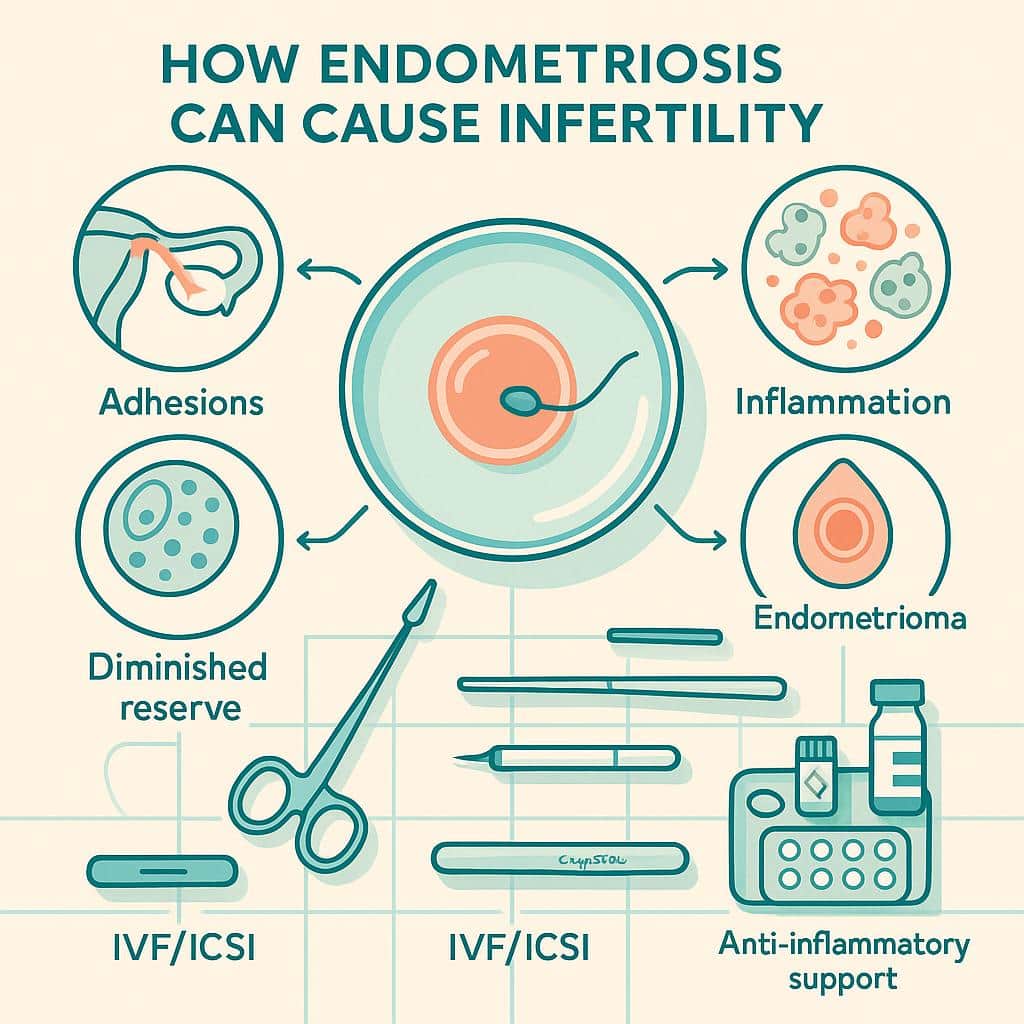
How Endometriosis Contributes to Infertility
How endometriosis leads to infertility: pathogenesis; effects on gametes, tubes, and endometrium; and treatments—expectant care, surgery, and ART.
How to Recognize Endometriosis Symptoms
Recognize endometriosis: painful periods, GI and urinary symptoms, dyspareunia, infertility. Understand causes, complications, diagnosis, and medical/surgical treatment options.