




Can Endometriosis Cause UTI Symptoms Without an Infection?
What bladder and ureter involvement can mean when urine tests are negative, and how to interpret treatment outcomes

UTI-like symptoms and the urinary tract - the short answer
If you have UTI symptoms but no UTI, endometriosis can be involved, including lesions in the bladder wall. Negative urine cultures and symptoms alone cannot establish that diagnosis, though. Bladder pain can occur without a visible bladder lesion, while ureter involvement may cause no urinary symptoms at all.
If you’d like a specialist’s view of your imaging findings or a recommended treatment, our team can review your options.
Painful urination, burning, pressure, urgency, or uncommon cyclical blood in the urine can prompt consideration of bladder disease; pain is more typical than visible bleeding. See Bladder Endometriosis: Symptoms, Diagnosis, and Treatment Options for the symptom patterns.
Lack of urinary symptoms does not reliably rule out ureter involvement in deep endometriosis: a symptom-free ureter can still be obstructed, causing urine to back up into the kidney and threatening kidney function. Our guide explains silent ureter involvement and kidney assessment.
Bladder sensitization, pelvic nerve cross-talk, and overlapping pain conditions can also cause symptoms without a bladder lesion that needs removal. See Bladder Pain for that distinction.
What urinary tract studies count and who they study
Bladder and ureter findings in a selected surgical cohort
Urinary tract involvement is not synonymous with a bladder lesion. Bladder endometriosis involves the bladder wall, while ureteral disease may surround, compress, or involve the wall of a ureter, one of the tubes carrying urine from the kidneys to the bladder.
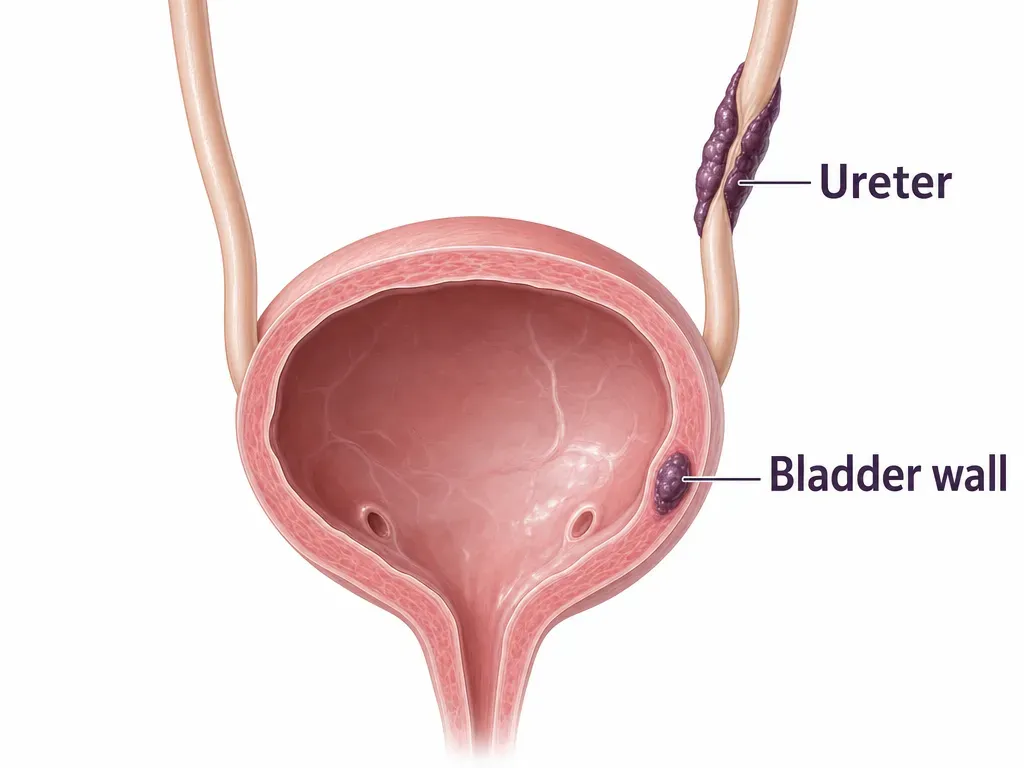
Urinary tract endometriosis can affect the bladder wall or a ureter, so urinary involvement does not always mean a bladder lesion.
In a 2025 retrospective study of 923 people undergoing surgery for deep endometriosis at a French expert center, 99 met the center’s urinary-lesion criteria, or 10.7%. Those criteria included partial bladder resection, extensive ureterolysis to free a ureter from surrounding disease, or ureteral resection. Superficial bladder shaving alone did not qualify.
Within those 99 patients, 86 underwent ureter procedures and 43 underwent bladder surgery. These groups overlap because some people needed both. Ureter involvement predominated under this study’s definition, but procedure counts do not establish how often each organ is affected among everyone with endometriosis.
Why an expert-center percentage is not population prevalence
An expert surgical center sees a selected group, often with extensive disease, previous operations, or symptoms that have not responded to medical treatment. Its percentage answers a narrower question: how often qualifying urinary involvement was found among the people operated on there.
A 2026 retrospective/prospective study of 80 consecutive patients undergoing laparoscopic surgery for deep bladder endometriosis at a Polish reference center illustrates another selection effect. In this bladder-focused group, 96.3% had other organ involvement, including the bowel in 87.5%, the uterus in 61.3%, and the ureters in 37.5%.
Those figures describe complex bladder disease treated surgically, not the likelihood that someone with UTI-like symptoms has disease in all those locations. The difference between the French urinary cohort and the Polish bladder cohort reflects both whom the centers treated and what they counted.
For an individual appointment, a symptom timeline remains useful even though it cannot locate a lesion. Bring these questions into your notes:
- Do symptoms flare before or during periods?
- Is pain tied to bladder filling or urination?
- Have there been episodes of visible blood in the urine, especially cyclical episodes?
- Has there been one-sided flank pain, nausea, or repeated diagnoses of kidney infections?
An unexpected cyclical bleeding pattern deserves attention even when an initial examination or ultrasound is normal. In a 2025 case report of a 42-year-old woman with cyclical urinary and belly-button bleeding, biopsies confirmed both bladder and umbilical endometriosis. This was an unusual presentation, not a typical symptom combination.
Physical examination and MRI can be quite specific when they identify a lesion, but their limited sensitivity means reassuring results do not always exclude urinary involvement. See the evaluation guide for how assessment can include ureter narrowing, kidney swelling, and kidney function when obstruction is present.
Cystoscopy can visualize a suspected bladder lesion and allow biopsy confirmation, as it did in the 2025 bleeding case. The guide also explains when cystoscopy and biopsy may help.
How confidently treatment studies measure urinary outcomes
Symptom improvement is not the same as durable urinary function
Urinary tract surgery can substantially improve symptoms, but the meaning of an outcome depends on what was measured and when. A lower pain score, stopping pain medication, no visible recurrence, and preserved kidney function are different results.
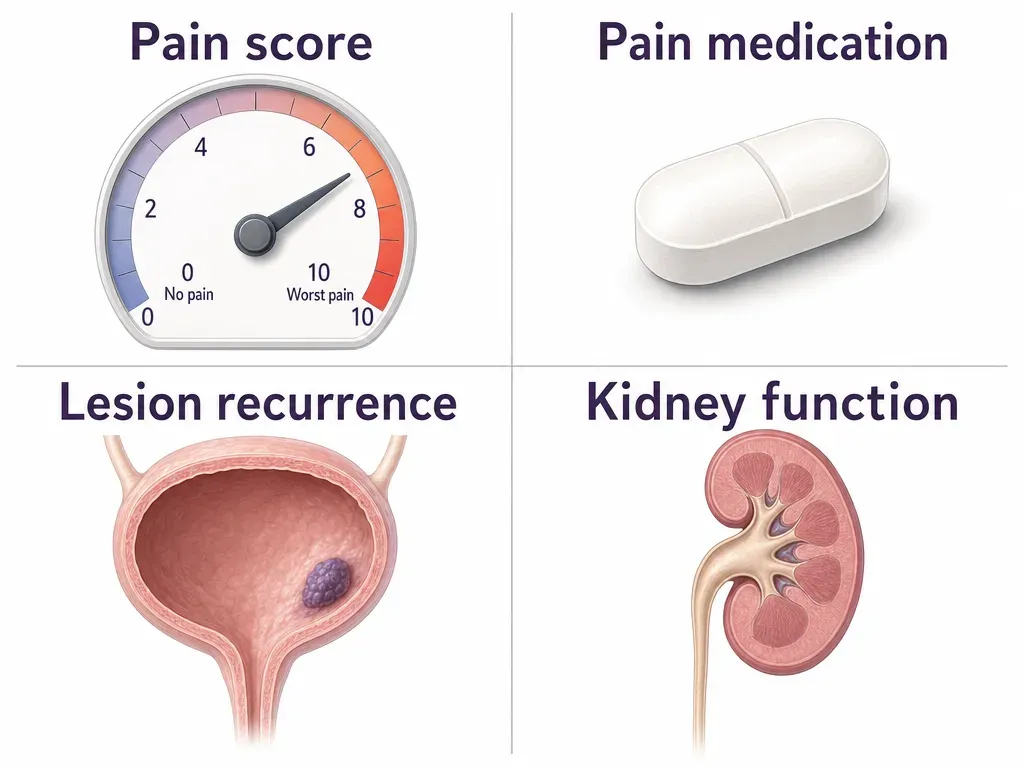
Pain relief after urinary tract endometriosis surgery does not, on its own, show whether lesions return or kidney function is preserved.
In a 2025 retrospective Polish study of 29 patients undergoing laparoscopic surgery for bladder or vesicouterine pouch endometriosis, 18 returned for six-month follow-up. Among the 10 with bladder endometriosis, the median painful-urination score fell from 9 to 0 on a 0–10 scale. Period pain and pain between periods also improved, while changes in painful bowel movements and pain with sex did not show clear statistical improvement.
In the 2025 French urinary cohort, 85% reported no need for pain medication one month after surgery. That is encouraging early symptom information, but it does not establish that urinary symptoms resolved or that bladder and kidney function remained normal years later.
Later outcomes also need careful interpretation. The French cohort reported three deep-endometriosis recurrences during follow-up, while the smaller Polish surgical cohort reported painful urination returning in some bladder patients around two years later on average. Symptom return and confirmed lesion recurrence are not interchangeable, and both are reasons that long-term follow-up and a plan for medical management after surgery can matter.
UTI Symptoms, Negative Cultures? Talk to a Specialist
Our specialists are here to help you understand your condition and explore your treatment options.
Schedule a ConsultationSmall cohorts and overlapping disease complicate the results
Small groups make it harder to distinguish a consistent treatment effect from individual variation. Variable follow-up and missing follow-up visits also limit confidence in how long improvement lasts.
Simultaneous treatment matters, too. Someone may have bladder, bowel, ureteral, and other pelvic disease treated during the same operation, so improvement cannot always be attributed to the urinary procedure alone. Removing a bladder lesion without addressing adjacent deep disease may leave symptoms behind.
Quality of life, sexual function, fertility, and long-term urinary function are inconsistently measured. Results from highly experienced centers may also differ from results elsewhere, so a favorable symptom percentage is not a personal guarantee.
In a 2026 bladder-filling study of 71 participants with chronic pelvic pain, with or without endometriosis or bladder symptoms, and pain-free controls, those with bladder symptoms reported more pain during filling than controls. Pain and urgency profiles did not neatly distinguish endometriosis from bladder pain syndrome, and filling pain correlated with gastrointestinal symptom severity.
No visible bladder lesions were reported in that study’s subgroup with endometriosis-associated pain and bladder symptoms. This supports considering bladder sensitization and overlapping pelvic pain, rather than assuming every bladder symptom requires bladder surgery.
Hormonal suppression, including progestins, can reduce bleeding and inflammation and is often a first-line option when symptoms are manageable and there is no obstruction or kidney threat; obstruction changes the need for surgery. See hormonal treatment versus surgery for the individual decision.
The woman in the 2025 bladder-and-umbilical bleeding case remained symptom-free during two months of progestin treatment. That demonstrates a short-term possibility, not a general success rate or proof of lasting control.
Bladder operations range from shaving or mucosal skinning to full-thickness resection, depending on lesion depth and location rather than symptom intensity alone. Full-thickness disease affected more than a third of the 2026 bladder cohort and was linked to larger lesions; see Bladder & Ureter Endometriosis Surgery for the procedures.
Ureterolysis frees a ureter from surrounding endometriosis and fibrosis, while some cases require removal of a damaged segment and reimplantation into the bladder to protect urine flow and kidney function. The same guide explains ureter surgery and reconstruction.
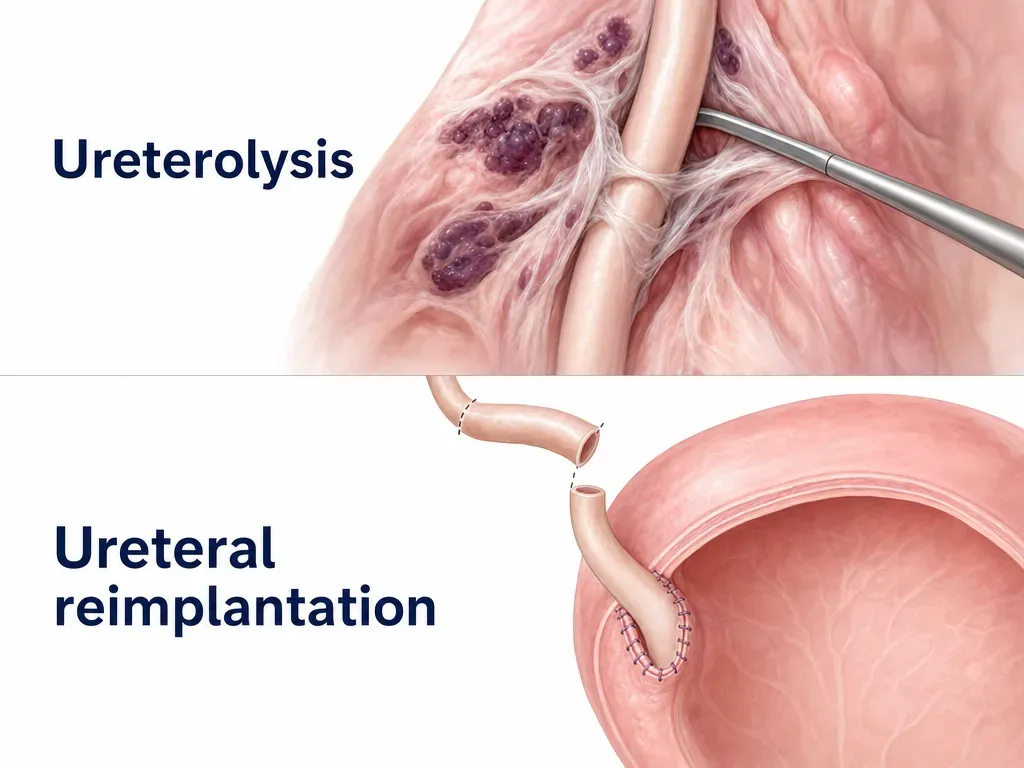
Ureter endometriosis surgery can range from freeing the ureter from surrounding disease to reimplanting it in the bladder in some cases to protect urine flow and kidney function.
Complications, recovery measures and newer surgical tools
Read complication rates in the context of surgical complexity
Urinary tract endometriosis surgery can be highly effective and still carry meaningful risks. Minimally invasive does not mean minor, particularly when several organs require treatment.
In the 2025 French urinary cohort, 17.2% had complications requiring surgical reintervention. Postoperative difficulty emptying the bladder requiring self-catheterization also occurred in a significant subset, sometimes continuing beyond a month.
The 2026 bladder-focused cohort reported postoperative complications in 10%. Higher risk was associated with larger lesions, full-thickness infiltration, involvement of the trigone near the ureter openings, multiple organs being opened, and previous surgery.
These percentages do not measure the same thing: one describes complications requiring another operation, while the other describes postoperative complications more broadly. Differences in disease severity, combined bowel or ureter procedures, and definitions prevent a simple comparison of surgical safety.
Complication figures do not by themselves make surgery a bad choice. The discussion needs to weigh the expected benefit, the extent of the operation, and the risk of leaving obstruction or other significant disease untreated.
In the 2026 bladder cohort, catheter use averaged roughly 10 days, longer with trigone involvement and resection or skinning rather than shaving, and hospital stay averaged roughly six days. These are planning context for time off and childcare help, not a personal timetable; see the recovery guidance for practical expectations.
A promising visualization tool is not a proven outcome benefit
Protecting the ureter is essential during complex pelvic surgery. The smaller 2025 Polish surgical cohort included a ureter injury that required conversion from laparoscopy to open surgery, illustrating how challenging distorted anatomy can be.
A 2026 surgical case report of a 29-year-old woman with deep endometriosis encasing and distorting a ureter described injecting indocyanine green dye into the ureter and using near-infrared fluorescence during robotic ureterolysis. The fluorescence helped the surgeons identify the ureter while separating it from surrounding fibrotic tissue.
That is a useful technical demonstration, but a single case cannot establish that fluorescence reduces injuries or long-term complications. Larger comparative data are needed, and better visualization does not replace an experienced team.
Complex urinary disease may require gynecology and urology, sometimes with colorectal surgery, in the same plan. Asking about assessment at a dedicated endometriosis referral center is reasonable; see multidisciplinary assessment and planning.
Questions to take to your doctor about the findings
Looking beyond a simple choice between UTI and endometriosis means considering the whole pelvis, urinary tract, and kidney risk. Symptoms do not map neatly to anatomy, so decisions depend on symptoms, findings, and organ risk together.
These questions can help you understand both your findings and any treatment percentages quoted to you:
- Could my symptoms reflect bladder endometriosis, ureter involvement, or bladder sensitization without a visible bladder lesion?
- Which urinary structures have been assessed? Does my imaging cover the kidneys and ureters, and was narrowing, hydroureter, or hydronephrosis found?
- Is the quoted frequency based on people like me or on a selected group undergoing complex surgery?
- Does the reported outcome describe urinary symptoms, pain-medication use, lesion recurrence, complications, or lasting kidney and bladder function? How long were people followed, and how many returned for follow-up?
- If a bladder lesion is suspected, would cystoscopy and biopsy help confirm it?
- If surgery is being considered, which operation is anticipated: shaving, skinning, full-thickness bladder resection, ureterolysis, or ureteral reimplantation?
- What would that operation mean for catheter time, recovery, and complication risk?
- Will planning involve gynecology, urology, and colorectal surgery if needed? How often does the team manage urinary tract endometriosis?
If you’d like a second opinion on urinary tract findings or a proposed operation, the Lotus Endometriosis Institute team can review your options.
References
. Urinary tract endometriosis: Revisiting the definition of ureterolysis. International Journal of Gynaecology and Obstetrics. 2025. PMID: 40631676 PMCID: PMC12724049
Palanisamy, Kothapalli, Palaniyandi et al.. Double Trouble: A Rare Clinical Presentation of Bladder and Umbilical Endometriosis. Cureus. 2025. PMID: 41479475 PMCID: PMC12754827
Van Trappen, Moawad, Ghysel et al.. Robotic-assisted resection of parametrial endometriosis with ureterolysis of a medially distorted ureter using indocyanine green and near-infrared fluorescence. Journal of Surgical Case Reports. 2026. PMID: 41523216 PMCID: PMC12782015
Szyłło, Szaflik, Gągorowski et al.. The outcomes of laparoscopic surgeries for urinary bladder and vesicouterine pouch endometriosis in the Polish population. Przegla̜d Menopauzalny = Menopause Review. 2025. PMID: 41694188 PMCID: PMC12895552
Coxon, Tan, Krassowski et al.. The value of a non-invasive bladder sensitivity paradigm in chronic pelvic pain. Reproduction & Fertility. 2026. PMID: 41705870 PMCID: PMC12974766
Mrugała, Fiutowski, Dąbrowska et al.. Bladder Endometriosis as Part of Complex Pelvic Deep Endometriosis: Surgical Challenges and Outcomes in a Reference Center. Journal of Clinical Medicine. 2026. PMCID: PMC12986077
Quick Answers
How is multi-organ endometriosis treated without organ removal?
In many multi-organ cases, conservative surgery removes endometriosis and frees organs from scar tissue while preserving the organs themselves. Robotic excision can improve precision, and treatment planning may include other surgical specialists.
Why do I have painful urination and pelvic cramping between periods?
Painful urination and pelvic cramping between periods can happen when the bladder, uterus, pelvic floor, or nerves are irritated. Endometriosis can contribute, but bladder pain syndrome, pelvic floor overactivity, or adenomyosis can also cause these symptoms.
What is deep infiltrating endometriosis (DIE) and how is it treated?
Deep infiltrating endometriosis (DIE) grows deeper into tissue and can affect organs like the bowel or bladder. Treatment depends on its location and effects; when surgery is appropriate, carefully removing the disease at its roots is the gold-standard approach.
Why does sex hurt more around my period?
Pain with sex that worsens around your period often points to inflammation and more reactive pelvic nerves before and during bleeding. Endometriosis can amplify pain signals, and adenomyosis can make the uterus unusually tender and crampy.