


Will Genetic Testing Help Diagnose Your Endometriosis Soon?
What new “risk signatures” really mean for you—and what they don’t
If you’ve spent years being told your pain is “normal,” it’s completely understandable to wish for a simple test that finally validates what you’re living with. Many people with endometriosis hope genetics will deliver that: a blood test, a cheek swab. Something! Anything! .... that shortens the 7–9 year diagnosis delay and gets you to treatment faster.
New genetic research is moving in that direction—but it’s not there yet. The most important takeaway is this: endometriosis risk appears to come from many small genetic factors that add up, not one or two “endometriosis genes.” That helps explain why diagnosis is still so hard and why treatments don’t work the same way for everyone. It also suggests where future therapies might come from—which is likely to be markedly different from what is recommended for treatment today.
What this kind of genetic research is
Traditional genetic studies often look for single genetic variants (single “spelling changes” in DNA) that are more common in people with endometriosis than people without it. Those single-variant signals are real, but they only explain a small slice of overall risk.
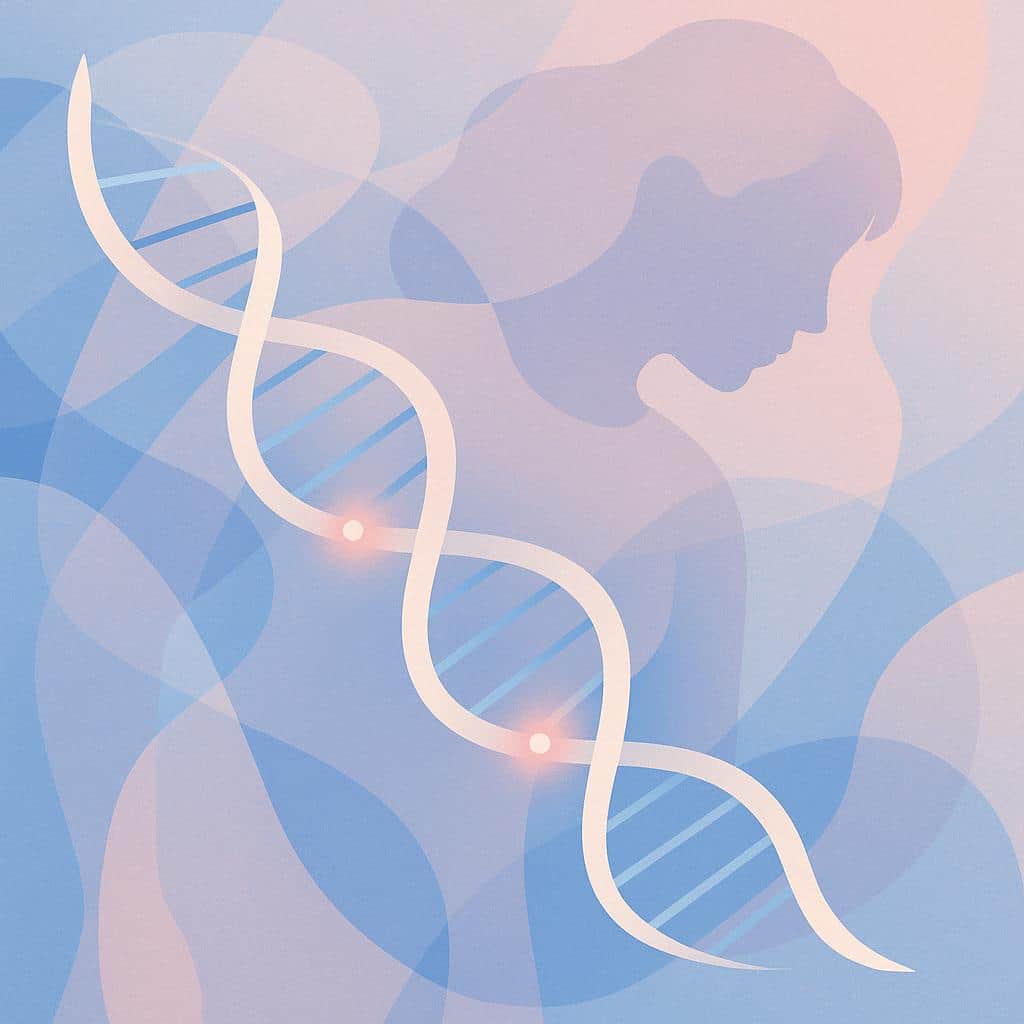
This newer approach looks for combinations of variants—small sets of 2–5 variants that tend to appear together more often in people with endometriosis. You can think of these as genetic “risk signatures.” The goal isn’t to say, “You have this signature, so you definitely have endometriosis.” It’s to see whether patterns of DNA differences point to biological processes that matter (like inflammation, scarring/fibrosis, nerve pain) and whether, one day, those patterns could help tailor treatments.
Does this mean a genetic test can diagnose endometriosis now?
Not based on the evidence we have.
In the research paper we reviewed, one specific two-variant signature showed a statistically significant association in an independent cohort, with an odds ratio around 1.21. That number may matter: but it’s a very small effect. Even if the association is real, it’s not strong enough to function as a stand-alone diagnostic test.
More broadly, most of the proposed signatures did not individually “replicate” with strong statistical certainty in the second dataset when correcting for the huge number of tests. Instead, the authors’ main argument is about directional consistency: across many signatures, more pointed toward higher risk in the second group than you’d expect by chance, especially for signatures that were relatively common.
What that means for you
- A DNA result would not be a yes/no answer for endometriosis right now.
- A “higher genetic risk” result would not replace imaging, symptoms, exam, or surgical diagnosis.
- A “lower genetic risk” result would not rule out disease—especially if your symptoms fit.
If you’re being dismissed today, a genetic test for these known variants is unlikely to be the validation tool you’re hoping for yet. Your symptoms, function, and treatment response still matter most in clinical care.
Could this eventually improve treatment (even if it doesn’t diagnose)?
Potentially—this is the more hopeful, practical angle.
Where genetic work can help patients over time is by pointing researchers toward the biology that drives symptoms in subgroups of patients. This paper highlights pathways that map onto things many of you recognize from lived experience:
- Fibrosis/scarring (which can contribute to pulling sensations, organ “stuck” pain, bowel/bladder symptoms, and pain with movement or sex)
- Neuropathic pain pathways (which may relate to burning, shooting pain, hypersensitivity, and pain that persists even after lesions are treated)
- Immune and inflammatory biology (including macrophage-related signals)
- Autophagy-related biology (a cellular “recycling”/stress-response process that, if altered, could influence inflammation and tissue behavior)
None of that gives you a new prescription today. But it supports a reality many patients already live: endometriosis is not one uniform disease experience, and future therapies may work better when matched to the dominant driver of your symptoms (inflammation vs fibrosis vs nerve sensitization, etc.). “It is a major gas-lighting fallacy that endometriosis is just one disease,” says Dr. Steven Vasilev, who guided the review of this peer-reviewed scientific publication. “It appears far more likely that endometriosis is a collection of similar diseases under a general symptom umbrella, with very different genetic and molecular drivers,” says Dr. Vasilev. “This would help explain why surgery or hormonal manipulation may work better, with more lasting results, in some patients over others,” he adds.
Explore Genetic Testing Options Today
Our specialists are here to help you understand your condition and explore your treatment options.
Schedule Your TestA crucial caveat if you also have adenomyosis
This study’s endometriosis definition in the UK dataset explicitly excluded adenomyosis codes. So if you have adenomyosis (with or without endometriosis), you should be cautious about assuming these genetic “signatures” apply to your situation.
That doesn’t mean adenomyosis has no genetic component. It means this particular set of findings can’t be confidently generalized to adenomyosis based on the way the data were defined.
If you’re considering direct-to-consumer genetic testing
Many patients ask whether services that provide “health risk” reports can help. Here’s the grounded answer:
Direct-to-consumer results may eventually incorporate more endometriosis-related signals, but today they’re unlikely to change your care plan, because:
- The effect sizes seen here are small (risk nudges, not risk determinants).
- These signatures haven’t been validated as a clinical diagnostic tool with the measures that matter (sensitivity, specificity, real-world accuracy).
- Most people carry some risk variants—having them doesn’t mean you’ll develop endometriosis, and not having them doesn’t mean you won’t.
If you choose to do genetic testing anyway, please understand that you are doing it for curiosity—not as your pathway to better or faster diagnosis or treatment.
Practical takeaways: how to use this information in real life
You deserve care that treats symptoms seriously now, not someday when genetics catches up. Use this research as a conversation tool—mainly to support the idea that endometriosis is complex and can involve inflammation, scarring, and nerve pain. These all have different, but potentially overlapping, molecular drivers.
Here are focused questions you can bring to your clinician (especially if symptoms persist despite first-line treatment):
- “Given my symptoms, do you think my pain has a neuropathic component—and if so, what are our treatment options beyond hormones?”
- “Do my symptoms suggest significant fibrosis/adhesions—and should I be evaluated by a surgeon with high-volume endometriosis expertise?”
- “If hormones haven’t helped enough, what’s our plan B for pain sensitization (pelvic floor PT, nerve pain medications, multidisciplinary pain care)?”
- “How are we addressing bowel/bladder symptoms—and when should we involve GI/urology?”
- “If I have suspected or confirmed adenomyosis, how does that change the plan?”
(That’s not because this paper tells you exactly what to do. It’s because it reinforces that different biological drivers can matter—and your plan should be individualized. IF these questions are met with a blank stare, you need another consultant.)
Reality check: what we still don’t know
This kind of research is promising, but it’s early.
- Association isn’t causation. These genetic patterns don’t prove what causes endometriosis or which pathway is driving your pain.
- Prediction is limited. The strongest individual signal reported still only modestly increases odds; it’s not diagnostic.
- Population differences matter. Findings from one ancestry group don’t always transfer cleanly to others, and “reproducibility” can look different depending on cohort size and how endometriosis was defined.
- Endometriosis vs adenomyosis vs overlap remains a major clinical reality—many patients have both, and research definitions don’t always match real-life complexity.
The most helpful way to hold this information is: genetics is slowly mapping the terrain, which may eventually improve targeted molecular treatments and shorten diagnosis delays. For today, your best path to relief right now is still evidence-based symptom management, access to experienced care, and a plan that takes your quality of life seriously. Consider getting an opinion from an endometriosis expert that is up-to-date as well as keeping up with future developments.
References
Sardell, Das, Møller, Sanna, Chocian, Taylor, Malinowski, Stubberfield, Rochlin, Gardner. Identification and Validation of Novel Combinatorial Genetic Risk Factors for Endometriosis across Multiple UK and US Patient Cohorts. medRxiv. 2025. PMCID: PMC12363715. PMID: 40832379.
Quick Answers
Why do I have painful urination and pelvic cramping between periods?
Painful urination with pelvic cramping between periods can happen when the bladder, ureters, uterus, pelvic floor, or nerves are irritated, sometimes in a subtle cycle pattern even if you’re not actively bleeding. Endometriosis can contribute by affecting the bladder wall or tissues around the bladder and ureters, and symptoms don’t have to include visible blood in the urine. Importantly, urinary tract endometriosis isn’t always obviously urinary, and ureter involvement can be quiet but still significant. That’s why we take these symptoms seriously.
These symptoms can also come from conditions that overlap with or mimic endometriosis, such as bladder pain syndrome/interstitial cystitis, pelvic floor overactivity, adenomyosis-related uterine cramping, or other pelvic pain drivers. In our evaluation, we focus on your full flare pattern: what triggers it, how it relates to your cycle, and whether urine tests have been repeatedly negative. We then use a targeted exam and the right imaging, often expertly interpreted ultrasound and/or MRI, to map what’s actually going on.
If you’re noticing recurring burning with urination, pressure, cramping, or symptoms that predictably flare mid-cycle or before your period, that pattern is useful diagnostic information, not something to dismiss. You can explore our urinary symptom and diagnostic evaluation resources to see how we approach UTI-like symptoms with negative cultures, and you’re welcome to reach out to schedule a consultation so our team can help you sort out whether this is bladder/ureter endometriosis, a look-alike condition, or a combination.
Why do I get low back and leg pain during my period?
Low back and leg pain that predictably flares with your period can happen when pelvic inflammation irritates pain pathways that refer pain to the back, hips, buttocks, and down the leg. In some patients, endometriosis can play a role: either indirectly (pelvic inflammation and scarring increasing pressure and sensitivity around nearby nerves) or more directly if the disease affects areas close to major nerves.
When period-related leg pain resembles sciatica, with deep buttock pain, tingling, burning, or pain radiating down the back of the thigh, it raises the possibility of endometriosis-related sciatic irritation or pelvic floor involvement (often described as piriformis-type pressure on the nerve). These symptoms may start before bleeding, peak during the period, and linger afterward. In more significant cases, they can be associated with weakness or changes in walking.
Because back and leg pain can also come from the spine, hips, or muscles, the key is the pattern and the full set of symptoms, including pelvic pain, bowel/bladder symptoms, or pain with sex. Our team can help you sort out whether your pain fits an endometriosis/adenomyosis pattern and, if needed, plan the next steps in evaluation, such as targeted imaging and a strategy focused on lasting relief rather than temporary suppression.
Can endometriosis cause infertility and pelvic pain in your 20s?
Yes. Endometriosis can absolutely show up in your late 20s and cause both chronic pelvic pain and fertility challenges. Pain can include severe or worsening period cramps, pain with sex, bowel or bladder pain, and flares that track with your cycle, although symptom severity doesn’t always match how much disease is present.
Endometriosis can affect fertility in several ways, including adhesions that distort tubo‑ovarian anatomy, inflammation and immune signaling that interfere with fertilization or embryo development, and ovarian factors, especially when endometriomas are involved. For some patients, the uterine environment also matters, particularly when adenomyosis is present alongside endometriosis. In our practice, we focus on listening to your full symptom and fertility story, then planning an evaluation that looks for endometriosis and checks for common look‑alikes or coexisting issues. This helps us tailor a plan to your goals, whether that’s pain relief, preserving fertility, or both.
Why is my period pain so severe it disrupts my daily life?
Severe, life-disrupting period pain isn’t normal cramps, and it often points to an underlying cause that deserves a real explanation, rather than symptom masking. One common cause is endometriosis, where tissue similar to the uterine lining grows outside the uterus and can irritate pelvic structures, trigger inflammatory chemicals, and sometimes involve organs like the bowel or bladder. Pain severity doesn’t reliably match stage, so someone can have intense pain even if imaging looks normal or disease appears limited.
When period pain is severe, worsens over time, starts years after your first period, or comes with heavy bleeding, painful sex, bowel pain with periods, urinary pain, or fatigue, we look for patterns because endometriosis and related conditions can overlap with pelvic floor dysfunction, nerve pain/central sensitization, GI dysbiosis, vascular issues, or adenomyosis. We take your full timeline and flare pattern seriously, then tailor the evaluation with a careful exam and expertly interpreted imaging when helpful. If your pain is disrupting school, work, relationships, or daily functioning, reach out to schedule a consultation. Our team can help you identify what’s driving it and map out a plan aimed at lasting relief.
How rare is endosalpingiosis?
Endosalpingiosis is generally considered uncommon, but how rare it is depends heavily on who’s being studied and how it’s found. Many cases are discovered incidentally on pathology, meaning tissue is identified under the microscope after surgery done for other reasons, so it’s likely underrecognized in the general population. In other settings, such as surgical cohorts, it may appear more often simply because more tissue is sampled and examined carefully.
What matters most for patients is that endosalpingiosis can be confused with endometriosis on imaging or even at surgery, but it doesn’t always behave the same way clinically. If you’ve been told you have endosalpingiosis and also have pelvic pain, bowel/bladder symptoms, or fertility concerns, our team can help interpret what that finding means in the context of your symptoms and operative/pathology reports. You’re welcome to explore our educational content on related endometriosis and uterine conditions, and reach out to schedule a consultation if you want a personalized plan.