



Could a Menstrual Blood Test Diagnose Endometriosis Earlier?
A simple dried-spot sample shows promise
If you’ve been told “it’s probably just bad periods,” or you’ve spent years bouncing between doctors, scans, and trial-and-error treatments, you already know the hardest part of endometriosis isn’t only the pain—it’s the delay in diagnosis. Many people wait far too long, and that delay often affects school, work, relationships, and mental health.
That’s why the idea of a non-invasive test using menstrual blood gets so much attention. Recent evidence suggests that the “chemical fingerprints” in period blood may differ in people with endometriosis—and that those differences might eventually be used as a screening test.
One early (pilot) study looked at whether fat-like molecules called lipids in a small dried spot of menstrual blood could help tell who had endometriosis and who didn’t. The results are encouraging—but it’s important to understand what this does (and doesn’t) mean for you right now.
What is a “menstrual blood lipid” test, in plain language?
Your menstrual blood contains more than blood—it also includes uterine lining tissue, fluid with inflammatory signals, and lots of molecules your body uses for structure and signaling. Lipids are one big category of these molecules. They’re not just “dietary fat”; they include compounds involved in cell membranes, inflammation, and immune signaling.
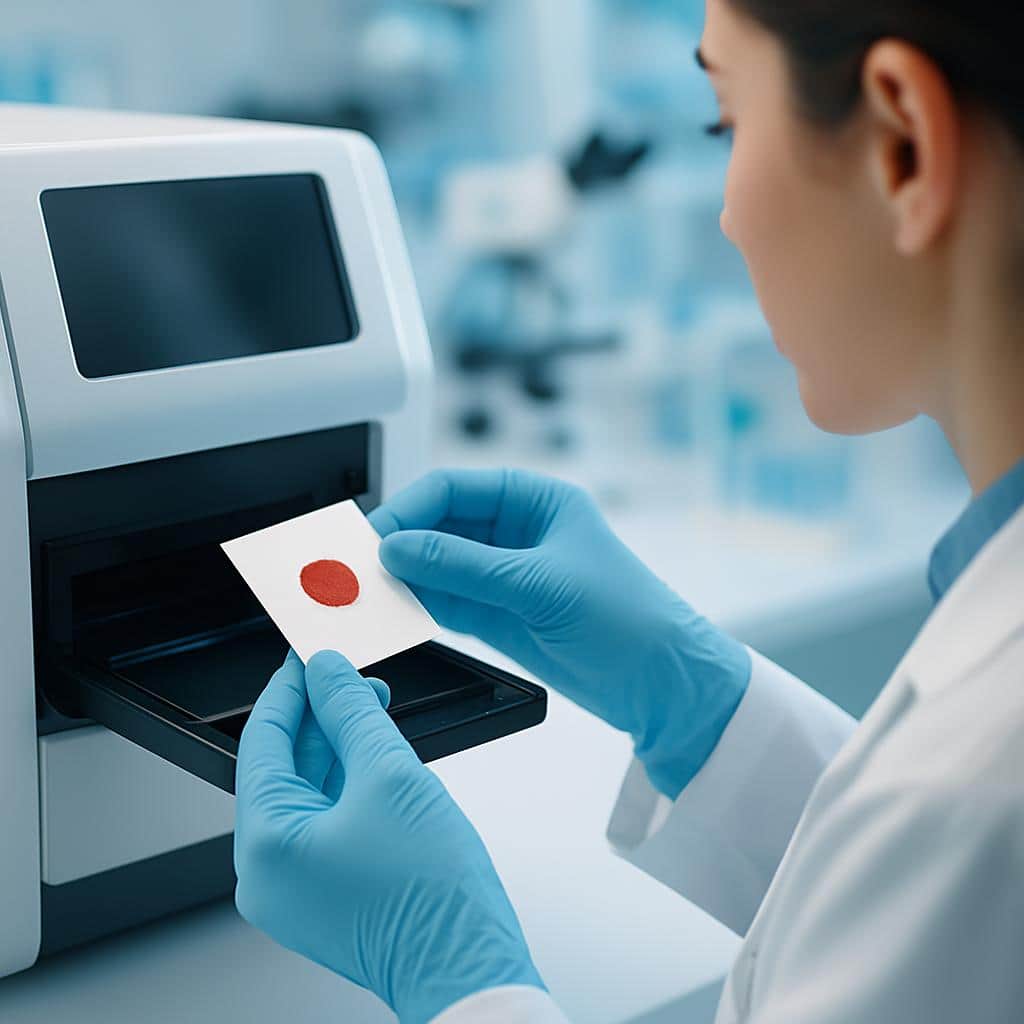
In this approach, menstrual blood is collected as a dried spot (think: a small sample blotted onto paper), then analyzed in a lab using advanced equipment to measure many lipids at once. The long-term goal is practical: if certain lipid patterns reliably match endometriosis, you could someday have a simpler test that helps clinicians decide who needs more targeted imaging, specialist referral, or surgery.
How well did it work in this early research?
In this pilot study, a model based on two specific lipids was able to separate people with endometriosis from controls with:
- Sensitivity: 81% (about 81 out of 100 people with endometriosis would test “positive”)
- Specificity: 85% (about 85 out of 100 people without endometriosis would test “negative”)
Those numbers are promising for an early-stage screen—especially because the sample collection could be relatively easy. But there’s a big catch: this accuracy was measured using internal validation (splitting the same small dataset into training/testing repeatedly). That’s useful for early development, but it often looks better than results in real-world clinics.
In other words: it’s a strong “this might be possible,” not yet “this is ready for you to order.”
What did they actually find was different in endometriosis?
This research suggests that certain lipid classes were higher in menstrual blood among people with endometriosis, including some types of:
- Ceramides and sphingomyelins (lipids often linked with inflammation and cell signaling)
- Cardiolipins (lipids associated with cellular energy structures)
- Triacylglycerols and some oxidized lipids (which can reflect inflammatory/oxidative processes)
They also reported lower levels of some phospholipid subtypes (certain phosphatidylcholines), while other related subtypes were higher. One lipid (a cardiolipin) was not only higher in endometriosis but also tended to be higher with more advanced stage in this dataset.
For you as a patient, the key point isn’t memorizing lipid names. It’s this: period blood seems to carry measurable signals that may track with endometriosis, which supports the idea that menstrual blood could become a useful diagnostic sample—more directly tied to the pelvis than a standard blood draw.
Don't Wait to Get Diagnosed
Our specialists are here to help you understand your condition and explore your treatment options.
Schedule Your TestCould this replace laparoscopy, ultrasound, or MRI?
Not at this stage.
A potential menstrual blood test—if it becomes real—would most likely function as a screening or triage tool, not a full replacement for expert evaluation and treatment decisions. Here’s why:
- Endometriosis isn’t one uniform disease; lesion types, genetic and molecular signaling, as well as lesion locations vary widely.
- Imaging (especially expert ultrasound and MRI in the right hands) can identify endometriomas and deep endometriosis, and can also suggest adenomyosis or bowel/bladder involvement—information a lipid test wouldn’t provide.
- Surgery can diagnose and sometimes treat with excision at the same time, in the hands of an endometriosis excision specialist.
A realistic future pathway might look like: symptoms → non-invasive test + imaging → faster referral to a specialist → more confident decision about treatment options. But we’re not there yet.
What this means for your real life right now
If you’re hoping this could finally be “the test” that proves what you feel, it’s completely understandable. Many patients want objective validation after years of dismissal. This line of research is hopeful because it aims to reduce diagnostic delay and make evaluation more accessible.
But today, this should not change your care plan by itself. There is no clinically validated, widely available menstrual blood lipid test you can rely on for diagnosis yet. If someone is marketing a “proven” period-blood lipid test for endometriosis based on early pilot results, that’s a red flag.
Who might benefit most if this becomes a real test?
If validated in larger and more diverse groups, a dried-spot menstrual blood test could be especially helpful for people who:
- have classic symptoms but inconclusive initial evaluations
- face long waits to see an endometriosis specialist
- can’t easily access expert imaging
- want a non-invasive step to make better informed decisions before considering surgery
It could also potentially help in places where healthcare access is limited—because dried spot collection can be simpler to transport than many other biological samples.
Practical takeaways: how to use this information at your next appointment
You don’t need to bring lipid names to your doctor. You can use this to push for a more thoughtful diagnostic plan.
Here are questions worth asking (and they apply even without any new test):
- “Given my symptoms, what’s your plan to evaluate for endometriosis and adenomyosis beyond basic ultrasounds?”
- “Can you refer me for expert pelvic ultrasound or MRI with a radiologist/team experienced in endometriosis?”
- “If imaging is negative, how will we decide between medical management vs referral to an endometriosis surgeon?”
- “What’s the timeline for reassessing if treatment doesn’t work—months, not years?”
Reality check: what we still don’t know
This research is fairly early. Before any test like this can be trusted in clinics, it needs to show it works in larger independent groups and in the kinds of patients who show up in real life (different ages, weights, hormones/contraception use, bleeding patterns, comorbid adenomyosis, fibroids, PCOS, postpartum changes, etc.).
It also needs to answer practical questions patients care about:
Will results change depending on cycle day, heavy vs light bleeding, using a hormonal IUD, taking continuous birth control, or having recent surgery? What about people who don’t menstruate regularly? How often would it be wrong—and what happens to patients who get false reassurance?
For now, the most useful way to think about this is: menstrual blood is emerging as a promising place to look for diagnostic clues. It makes sense and the research is continuing. But waiting for this is not an option. You still deserve a full expert clinical evaluation based on your symptoms, exam, and appropriate imaging/referral.
References
Starodubtseva N, Chagovets V, Tokareva A, Dumanovskaya M, Kukaev A, Novoselova D, Frankevich V, Pavlovich S, Sukhikh G. Diagnostic Value of Menstrual Blood Lipidomics in Endometriosis: A Pilot Study. Biomolecules. 2024. DOI: 10.3390/biom14080899
Quick Answers
Why do I have painful urination and pelvic cramping between periods?
Painful urination with pelvic cramping between periods can happen when the bladder, ureters, uterus, pelvic floor, or nerves are irritated, sometimes in a subtle cycle pattern even if you’re not actively bleeding. Endometriosis can contribute by affecting the bladder wall or tissues around the bladder and ureters, and symptoms don’t have to include visible blood in the urine. Importantly, urinary tract endometriosis isn’t always obviously urinary, and ureter involvement can be quiet but still significant. That’s why we take these symptoms seriously.
These symptoms can also come from conditions that overlap with or mimic endometriosis, such as bladder pain syndrome/interstitial cystitis, pelvic floor overactivity, adenomyosis-related uterine cramping, or other pelvic pain drivers. In our evaluation, we focus on your full flare pattern: what triggers it, how it relates to your cycle, and whether urine tests have been repeatedly negative. We then use a targeted exam and the right imaging, often expertly interpreted ultrasound and/or MRI, to map what’s actually going on.
If you’re noticing recurring burning with urination, pressure, cramping, or symptoms that predictably flare mid-cycle or before your period, that pattern is useful diagnostic information, not something to dismiss. You can explore our urinary symptom and diagnostic evaluation resources to see how we approach UTI-like symptoms with negative cultures, and you’re welcome to reach out to schedule a consultation so our team can help you sort out whether this is bladder/ureter endometriosis, a look-alike condition, or a combination.
Why does ovarian cyst pain keep coming back?
Ovarian cyst pain can feel recurrent for a few different reasons. Some cysts are functional: they form with ovulation and then resolve, so the pain returns in a similar spot month after month even though it’s not the exact same cyst. In other cases, the cyst itself can come back or persist, especially if it’s an endometrioma (an ovarian cyst caused by endometriosis), which can behave differently than a simple cyst and may be associated with deeper pelvic disease.
Another common reason is that the cyst isn’t the whole story: endometriosis on the pelvic sidewall, uterosacral ligaments, bowel, bladder, or around the ovary can irritate the same nerves and tissues. This can make it feel like the cyst is back when the pain is actually driven by inflammatory disease nearby. Adhesions (scar-like bands) can also tether the ovary and cause recurring pulling or sharp pain, even when imaging doesn’t show a large cyst. If your pain cycles, escalates, returns quickly after a normal ultrasound, or keeps recurring despite prior treatment, our team can help you map the pattern, interpret imaging with an endometriosis lens, and decide whether targeted evaluation and, when appropriate, excision surgery is the next best step.
Why do I get low back and leg pain during my period?
Low back and leg pain that predictably flares with your period can happen when pelvic inflammation irritates pain pathways that refer pain to the back, hips, buttocks, and down the leg. In some patients, endometriosis can play a role: either indirectly (pelvic inflammation and scarring increasing pressure and sensitivity around nearby nerves) or more directly if the disease affects areas close to major nerves.
When period-related leg pain resembles sciatica, with deep buttock pain, tingling, burning, or pain radiating down the back of the thigh, it raises the possibility of endometriosis-related sciatic irritation or pelvic floor involvement (often described as piriformis-type pressure on the nerve). These symptoms may start before bleeding, peak during the period, and linger afterward. In more significant cases, they can be associated with weakness or changes in walking.
Because back and leg pain can also come from the spine, hips, or muscles, the key is the pattern and the full set of symptoms, including pelvic pain, bowel/bladder symptoms, or pain with sex. Our team can help you sort out whether your pain fits an endometriosis/adenomyosis pattern and, if needed, plan the next steps in evaluation, such as targeted imaging and a strategy focused on lasting relief rather than temporary suppression.
Can endometriosis cause infertility and pelvic pain in your 20s?
Yes. Endometriosis can absolutely show up in your late 20s and cause both chronic pelvic pain and fertility challenges. Pain can include severe or worsening period cramps, pain with sex, bowel or bladder pain, and flares that track with your cycle, although symptom severity doesn’t always match how much disease is present.
Endometriosis can affect fertility in several ways, including adhesions that distort tubo‑ovarian anatomy, inflammation and immune signaling that interfere with fertilization or embryo development, and ovarian factors, especially when endometriomas are involved. For some patients, the uterine environment also matters, particularly when adenomyosis is present alongside endometriosis. In our practice, we focus on listening to your full symptom and fertility story, then planning an evaluation that looks for endometriosis and checks for common look‑alikes or coexisting issues. This helps us tailor a plan to your goals, whether that’s pain relief, preserving fertility, or both.
Why do I have chronic fatigue and pelvic pain?
Chronic fatigue and pelvic pain often feel unexplainable because they’re rarely caused by just one issue, and many of the most common drivers don’t show up on routine labs or a quick ultrasound. Endometriosis and adenomyosis can cause persistent pelvic pain, painful periods, bowel and bladder symptoms, and deep fatigue through inflammation, disrupted sleep, heavy bleeding (and possible iron deficiency), and the sheer energy cost of living with ongoing pain. It’s also common for more than one gynecologic condition to coexist, including fibroids, polyps, or benign cysts, so a single label may not fully capture what you’re experiencing.
Another reason symptoms can persist is that the nervous system can become more pain-sensitive over time, often called central sensitization. This means pain can spread, linger outside your cycle, or feel disproportionate to what imaging shows. In those cases, symptom relief alone can miss the bigger picture: we think in terms of both treating disease (for example, addressing endometriosis lesions or uterine drivers like adenomyosis or fibroids) and building a personalized pain-management plan so your body can turn down the volume on pain signals.
If your fatigue and pelvic pain have been brushed off or left without a clear plan, our team can help you sort through the likely contributors, including endometriosis, adenomyosis, and common coexisting conditions, and map out next steps that fit your goals. You can explore our educational resources on fatigue, chronic pelvic pain, and comprehensive treatment approaches, and reach out to schedule a consultation when you’re ready.