


Endometriosis and Adenomyosis: How They Drive Pelvic Pain
A side-by-side guide to how these conditions overlap, differ, and drive pelvic pain.
Endometriosis and Adenomyosis: Similarities, Differences, Associations, and Research
Endometriosis and adenomyosis affect millions of women worldwide. While they share certain similarities, they also differ in their pathophysiology, clinical presentation, and management. Comparing and contrasting these conditions helps clarify their overlap, distinctions, and related health associations, with relevant references noted throughout.
Similarities
Both endometriosis and adenomyosis involve the growth of endometrial-like tissue outside the uterine cavity. This ectopic tissue remains responsive to hormonal changes, leading to inflammation, pain, and other similar symptoms that can significantly interfere with quality of life (1). Both conditions predominantly affect women of reproductive age and are associated with dysmenorrhea (painful periods), dyspareunia (painful intercourse), and infertility (2). Although the exact causes are unclear, a combination of genetic, hormonal, and immune factors is thought to contribute to both (3). Either condition can also continue beyond menopause or even be present initially after menopause.
Key Differences
Anatomical location
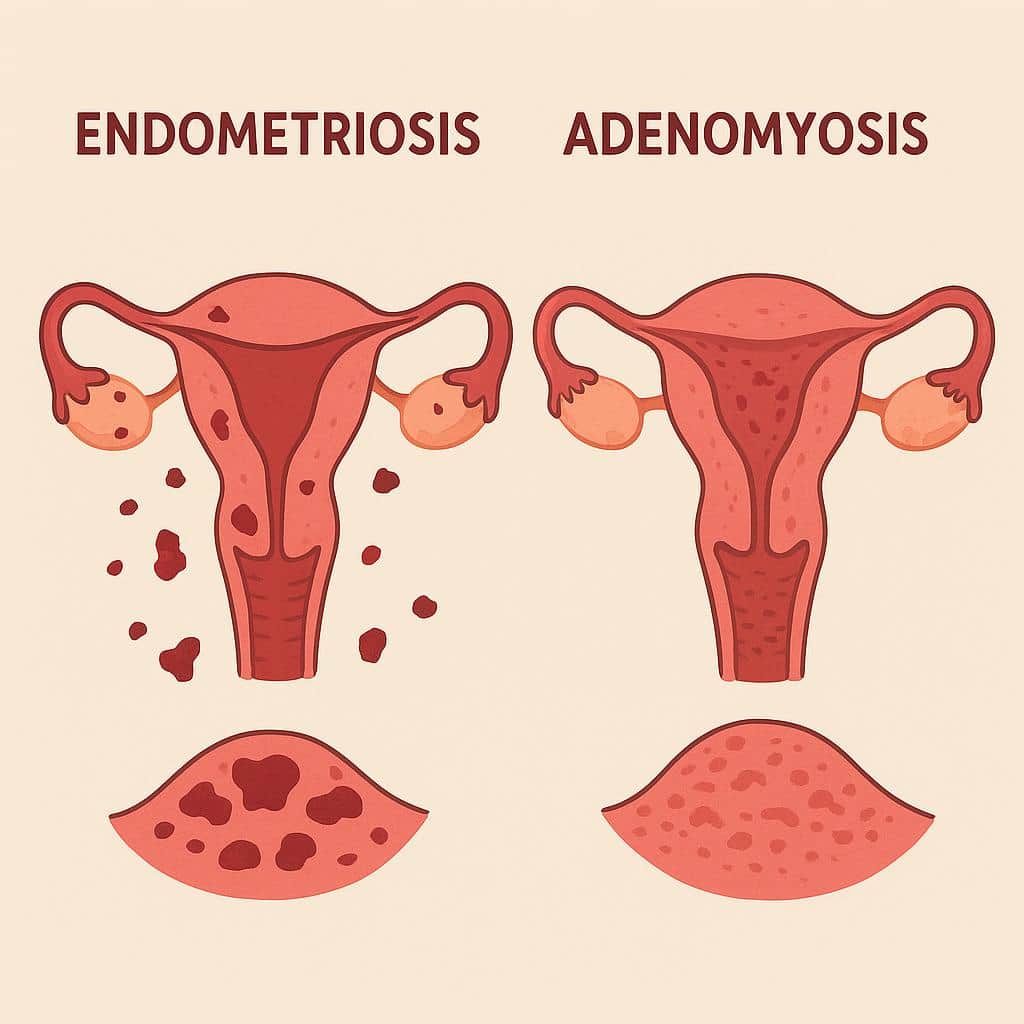
Although both conditions involve ectopic endometrial-like tissue, they differ in anatomical location. Endometriosis is characterized by endometrial-like tissue outside the uterus, commonly on the ovaries, fallopian tubes, the peritoneum (the pelvic and abdominal skin-like lining), and other organs (4). Adenomyosis, by contrast, is defined by the invasion of endometrial-like tissue into the myometrium, the muscular wall of the uterus (5).
Prevalence
Endometriosis affects approximately 10% of women of reproductive age, whereas adenomyosis is thought to impact between 20% and 35% in this group (6). The true prevalence of both conditions may be underestimated due to the invasive nature of diagnostic procedures and non-specific symptoms (7).
Diagnosis
The gold standard for diagnosing endometriosis is surgery using laparoscopy or robotics, both minimally invasive procedures that allow direct visualization and, if necessary, excision of endometrial-like lesions (8). Adenomyosis, on the other hand, is typically suspected using imaging techniques such as transvaginal ultrasound or magnetic resonance imaging (MRI) and is usually confirmed by a pathologist when the uterus is removed (9). An accurate preoperative biopsy is very difficult; however, when adenomyosis is not diffuse throughout the myometrium, discrete adenomyomas can sometimes be removed while leaving the uterus in place.
Treatment
Both conditions are managed with a combination of medical and surgical therapies tailored to symptom severity and reproductive goals. Hormonal therapies—including oral contraceptives, progestins, and gonadotropin-releasing hormone (GnRH) agonists and antagonists—are commonly used to manage symptoms in both endometriosis and adenomyosis (10). Integrative measures, including anti-inflammatory and anti-oxidant hormone-modulating nutrition and lifestyle modifications, can help control symptoms and may contribute to treating root causes. Surgical approaches differ by condition. In endometriosis, the preferred intervention is laparoscopic or robotic excision of ectopic tissue (11). For adenomyosis, hysterectomy (removal of the uterus) may be considered in severe cases when fertility preservation is not a concern (12). In selected cases where imaging identifies discrete adenomyomas, removal while preserving the uterus is possible; the decision to remove the uterus is highly individualized.
Struggling with Pelvic Pain? Get Help Now
Our specialists are here to help you understand your condition and explore your treatment options.
Schedule Your VisitCoexistence and Associated Conditions
Endometriosis and adenomyosis can coexist in the same patient, and one study found that adenomyosis is significantly more prevalent among women with endometriosis (13). Coexistence may exacerbate symptoms and complicate both diagnosis and management (14). These conditions are also linked to other health issues. Women with either may experience chronic pelvic pain that can be debilitating and significantly impact daily life (15). Adenomyosis and uterine fibroids (leiomyomas) may occur together, which can further complicate diagnosis and treatment despite being distinct entities (16). Women with endometriosis have an increased risk of autoimmune and inflammatory disorders—such as rheumatoid arthritis, systemic lupus erythematosus, and inflammatory bowel disease—while similar associations with adenomyosis are less well-established but have been suggested in some studies (17, 18). Mental health concerns, including depression, anxiety, and decreased quality of life due to chronic pain and infertility, are linked to both conditions (19).
Research and Future Directions
There is a growing body of research targeting the pathophysiology, diagnosis, and treatment of endometriosis and adenomyosis. Key areas include the identification of specific biomarkers to improve diagnostic accuracy and enable earlier intervention (20), advances in non-invasive imaging techniques to reduce reliance on invasive diagnostic procedures (21), exploration of novel therapeutic approaches such as targeted hormonal therapies, immunomodulators, and anti-inflammatory agents to improve symptom control and fertility outcomes (22), and investigation of genetic and epigenetic factors that drive development and progression to inform future treatment strategies (23).
References
Vercellini P, Viganò P, Somigliana E, Fedele L. (2014). Endometriosis: pathogenesis and treatment. Nat Rev Endocrinol. 10(5): 261-75. DOI: 10.1007/s10735-025-10499-z
Parazzini F, Esposito G, Tozzi L, Noli S, Bianchi S. (2017). Epidemiology of endometriosis and its comorbidities. Eur J Obstet Gynecol Reprod Biol. 209: 3-7. DOI: 10.1016/j.rbmo.2025.105102
Zondervan KT, Becker CM, Koga K, Missmer SA, Taylor RN, Viganò P. (2018). Endometriosis. Nat Rev Dis Primers. 4(1): 9.
Giudice LC, Kao LC. (2004). Endometriosis. Lancet. 364(9447): 1789-99. DOI: 10.1007/s00210-025-04935-w
Vannuccini S, Tosti C, Carmona F, Huang SJ, Chapron C, Guo SW, Petraglia F. (2017). Pathogenesis of adenomyosis: an update on molecular mechanisms. Reprod Biomed Online. 35(5): 592-601. DOI: 10.1016/j.rbmo.2017.06.016
Garcia L, Isaacson K. (2011). Adenomyosis: review of the literature. J Minim Invasive Gynecol. 18(4): 428-37. DOI: 10.3390/jcm14051430
Chapron C, Marcellin L, Borghese B, Santulli P. (2019). Rethinking mechanisms, diagnosis and management of endometriosis. Nat Rev Endocrinol. 15(11): 666-82. DOI: 10.1038/s41574-019-0245-z
Johnson NP, Hummelshoj L, Adamson GD, Keckstein J, Taylor HS, Abrao MS, et al. (2017). World Endometriosis Society consensus on the classification of endometriosis. Hum Reprod. 32(2): 315-24. DOI: 10.1093/humrep/dew293
Champaneria R, Abedin P, Daniels J, Balogun M, Khan KS. (2010). Ultrasound scan and magnetic resonance imaging for the diagnosis of adenomyosis: systematic review comparing test accuracy. Acta Obstet Gynecol Scand. 89(11): 1374-84. DOI: 10.3109/00016349.2010.512061
Vercellini P, Buggio L, Berlanda N, Barbara G, Somigliana E, Bosari S. (2016). Estrogen-progestins and progestins for the management of endometriosis. Fertil Steril. 106(7): 1552-71.e2. DOI: 10.1080/14728214.2023.2296080
Yeung P Jr, Sinervo K, Winer W, Albee RB Jr. (2011). Complete laparoscopic excision of endometriosis in teenagers: is postoperative hormonal suppression necessary? Fertil Steril. 95(6): 1909-12, 1912.e1. DOI: 10.1016/j.fertnstert.2011.02.037
García-Solares J, Donnez J, Donnez O, Dolmans MM. (2018). Pathogenesis of uterine adenomyosis: invagination or metaplasia? Fertil Steril. 109(3): 371-9. DOI: 10.1158/2159-8290.CD-25-0778
Mijatovic V, Florijn E, Halim N, Schats R, Hompes P. (2010). Adenomyosis has no adverse effects on IVF/ICSI outcomes in women with endometriosis treated with long-term pituitary down-regulation before IVF/ICSI. Eur J Obstet Gynecol Reprod Biol. 151(1): 62-7. DOI: 10.1016/j.ejogrb.2010.02.047
Pinzauti S, Lazzeri L, Tosti C, Centini G, Orlandini C, Luisi S, et al. (2015). Coexistence of endometriosis and adenomyosis in women with chronic pelvic pain. J Obstet Gynaecol Res. 41(6): 909-14. PMID: 23610949
Howard FM. (2003). Chronic pelvic pain. Obstet Gynecol. 101(3): 594-611. DOI: 10.1016/j.jmig.2026.01.014
Stewart EA. (2015). Uterine fibroids. Lancet. 387(10022): 1189-99. DOI: 10.1080/13625187.2026.2615974
Sinaii N, Cleary SD, Ballweg ML, Nieman LK, Stratton P. (2002). High rates of autoimmune and endocrine disorders, fibromyalgia, chronic fatigue syndrome and atopic diseases among women with endometriosis: a survey analysis. Hum Reprod. 17(10): 2715-24. DOI: 10.1093/humrep/17.10.2715
Benagiano G, Brosens I, Habiba M. (2015). Structural and molecular features of the endomyometrium in endometriosis and adenomyosis. Hum Reprod Update. 21(4): 445-58. DOI: 10.1093/humupd/dmt052
Roomaney R, Kagee A. (2016). The association between pain, disability, fatigue and depression in women diagnosed with endometriosis: a moderated mediation analysis. J Psychosom Obstet Gynaecol. 37(4): 137-44.
Nisenblat V, Bossuyt PM, Shaikh R, Farquhar C, Jordan V, Scheffers CS, et al. (2016). Blood biomarkers for the non-invasive diagnosis of endometriosis. Cochrane Database Syst Rev. 5: CD012179. DOI: 10.3390/healthcare13243276
Brosens I, Gordts S, Campo R, Benagiano G. (2016). Non-invasive methods of diagnosis of endometriosis. Curr Opin Obstet Gynecol. 28(4): 267-76. DOI: 10.3390/jcm15010030
Stratton P, Berkley KJ. (2011). Chronic pelvic pain and endometriosis: translational evidence of the relationship and implications. Hum Reprod Update. 17(3): 327-46. DOI: 10.1093/humupd/dmq050
Zondervan KT, Rahmioglu N, Morris AP, Nyholt DR, Montgomery GW, Becker CM, et al. (2016). Beyond endometriosis genome-wide association study: from genomics to phenomics to the patient. Semin Reprod Med. 34(4): 242-54. DOI: 10.1055/s-0036-1585408
Quick Answers
Why do I have painful urination and pelvic cramping between periods?
Painful urination with pelvic cramping between periods can happen when the bladder, ureters, uterus, pelvic floor, or nerves are irritated, sometimes in a subtle cycle pattern even if you’re not actively bleeding. Endometriosis can contribute by affecting the bladder wall or tissues around the bladder and ureters, and symptoms don’t have to include visible blood in the urine. Importantly, urinary tract endometriosis isn’t always obviously urinary, and ureter involvement can be quiet but still significant. That’s why we take these symptoms seriously.
These symptoms can also come from conditions that overlap with or mimic endometriosis, such as bladder pain syndrome/interstitial cystitis, pelvic floor overactivity, adenomyosis-related uterine cramping, or other pelvic pain drivers. In our evaluation, we focus on your full flare pattern: what triggers it, how it relates to your cycle, and whether urine tests have been repeatedly negative. We then use a targeted exam and the right imaging, often expertly interpreted ultrasound and/or MRI, to map what’s actually going on.
If you’re noticing recurring burning with urination, pressure, cramping, or symptoms that predictably flare mid-cycle or before your period, that pattern is useful diagnostic information, not something to dismiss. You can explore our urinary symptom and diagnostic evaluation resources to see how we approach UTI-like symptoms with negative cultures, and you’re welcome to reach out to schedule a consultation so our team can help you sort out whether this is bladder/ureter endometriosis, a look-alike condition, or a combination.
When is hysterectomy recommended for adenomyosis?
A hysterectomy is typically considered for adenomyosis when you’re not planning future pregnancy and symptoms are severe and clearly uterus-driven, most often heavy bleeding (sometimes with anemia), intense cramping, pelvic pressure, and disruption to daily quality of life. It’s the most definitive option because adenomyosis is within the uterine muscle, so removing the uterus removes the source of the problem.
In practice, we usually consider hysterectomy most seriously when conservative options haven’t brought acceptable relief, aren’t tolerated, or don’t fit your goals. The decision also depends on the pattern and extent of disease (diffuse adenomyosis versus a more focal adenomyoma that may be removable while preserving the uterus) and whether endometriosis may also be present. If endometriosis is part of the picture, it’s important to know that hysterectomy alone doesn’t treat disease outside the uterus. Durable symptom relief depends on addressing all pain generators.
If you’re wondering whether hysterectomy makes sense for you at this point, our team can help clarify what’s most likely driving your symptoms, review imaging, and walk you through uterus-preserving versus definitive surgical options so you can choose the one that best matches your relief and fertility priorities.
Which adenomyosis symptoms most affect daily life?
The adenomyosis symptoms that most disrupt quality of life usually involve two main issues: uterine bleeding and pain. Many patients describe heavy or prolonged periods that interfere with work, school, travel, and sleep, sometimes with flooding, frequent pad or tampon changes, and fatigue that can follow significant blood loss. Severe period pain (often worse than normal cramps) is also common. It can feel deep, aching, or pressure-like, sometimes accompanied by an enlarged, tender uterus and a sense of pelvic heaviness or bloating.
Outside of the period itself, adenomyosis can contribute to chronic pelvic pain, pain with sex for some people, and bowel or bladder discomfort, especially when symptoms flare around the menstrual cycle. It can also overlap with endometriosis, and when both are present, symptoms may intensify or become harder to tell apart. If bleeding, pain, pressure, or fertility stress is shaping your day-to-day life, our team can help you sort out whether adenomyosis, endometriosis, fibroids, or more than one condition may be causing your symptoms, and which next steps make sense for your goals.
Why do I look pregnant from bloating with constant pelvic pressure?
Feeling so bloated you look pregnant, along with constant pelvic pressure, usually points to more than simple gas. Often, it’s a pelvic condition creating inflammation, swelling, or a sense of bulk. Endometriosis can irritate the bowel and pelvic lining, trigger scarring that tethers organs, and create the classic “endo belly” sensation that comes and goes (sometimes not perfectly cyclical). Pelvic pressure can also happen when endometriosis involves deeper tissues or nearby organs like the bladder, ureters, or rectum.
Just as important, these symptoms can be driven by conditions related to or coexisting with endometriosis, especially adenomyosis and fibroids, which can make the uterus feel heavy, full, or bulky and add pressure on the bladder and bowel. Ovarian cysts and other benign pelvic findings can contribute, and IBS-like bowel sensitivity can overlap so closely that symptoms alone don’t reliably distinguish the causes. Our team focuses on mapping the full picture (uterus, ovaries, bowel, bladder, and pelvic support structures) so treatment targets the true driver or drivers, not just the most obvious diagnosis.
If this pressure and/or bloating is persistent, worsening, or changing your ability to eat, move your bowels, or urinate comfortably, it’s a strong reason to pursue a deeper evaluation rather than being told it’s “normal.” You can explore our educational content on bowel symptoms, bladder symptoms, and overlapping conditions, and reach out to schedule a consultation so we can review your history, imaging, and symptom pattern and outline a plan aimed at lasting relief.
Why does ovarian cyst pain keep coming back?
Ovarian cyst pain can feel recurrent for a few different reasons. Some cysts are functional: they form with ovulation and then resolve, so the pain returns in a similar spot month after month even though it’s not the exact same cyst. In other cases, the cyst itself can come back or persist, especially if it’s an endometrioma (an ovarian cyst caused by endometriosis), which can behave differently than a simple cyst and may be associated with deeper pelvic disease.
Another common reason is that the cyst isn’t the whole story: endometriosis on the pelvic sidewall, uterosacral ligaments, bowel, bladder, or around the ovary can irritate the same nerves and tissues. This can make it feel like the cyst is back when the pain is actually driven by inflammatory disease nearby. Adhesions (scar-like bands) can also tether the ovary and cause recurring pulling or sharp pain, even when imaging doesn’t show a large cyst. If your pain cycles, escalates, returns quickly after a normal ultrasound, or keeps recurring despite prior treatment, our team can help you map the pattern, interpret imaging with an endometriosis lens, and decide whether targeted evaluation and, when appropriate, excision surgery is the next best step.