



Can Hormone Treatment Calm Adenomyosis Symptoms Over Time? What an 18 Month Follow Up Study Found
An evidence-based look at 18‑month outcomes of hormone therapy for adenomyosis—symptom relief, ultrasound changes, side effects, and what it means for you.
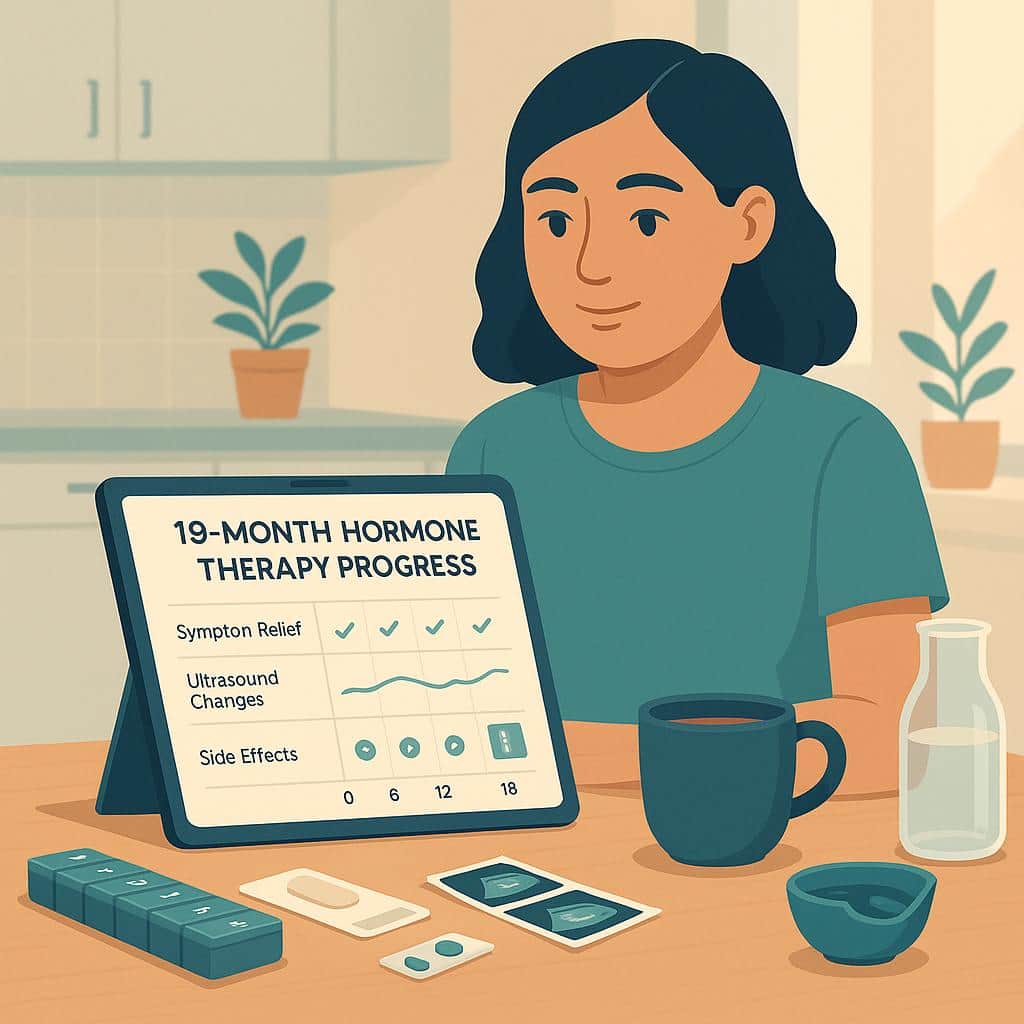
Living with adenomyosis can mean planning your life around pain and bleeding—painful periods (dysmenorrhea), heavy menstrual bleeding, and sometimes other ongoing pelvic pain symptoms that don’t neatly follow a calendar. If you also have endometriosis, the picture can feel even more complicated, because symptoms may overlap and imaging findings can change over time.
A 2025 study in the Journal of Personalized Medicine followed premenopausal people with ultrasound evidence of adenomyosis (with and without endometriosis) for 18 months to see what happened to symptoms and ultrasound findings in those who used continuous hormonal treatment compared with those who did not. This kind of real‑world, longer follow‑up matters because many patients are trying to decide whether staying on medication is “worth it” over time—especially when side effects are part of the trade‑off.
This article walks through what the study observed, what it might mean for day‑to‑day decision-making, and what the study cannot prove.
Key Findings
Why this study was done
The researchers aimed “to evaluate the impact of hormonal therapy” on painful symptoms over “an 18‑month follow‑up,” and they also wanted to “explore sonographic changes” (changes seen on ultrasound) alongside symptoms. In other words, they weren’t only asking, “Do people feel better?”—they also asked, “Does the uterus (and any coexisting endometriosis) look different on imaging over time?”
Importantly, this was described as a pilot retrospective observational study. That means the researchers looked back at what happened in a group of patients rather than randomly assigning treatment.
Who was included (and how adenomyosis/endometriosis were assessed)
The study included “40 women with ultrasound evidence of adenomyosis with and without endometriosis.” Symptoms were tracked using a VAS (Visual Analog Scale), described as a “10 cm Visual Analog Scale,” where 0 means no pain and 10 means the maximum pain.
Adenomyosis and endometriosis were assessed by ultrasound during follow‑up. The paper also notes that there is “no consensus currently exists within the MUSA group” for grading severity in a standardized way, which matters when interpreting how “mild” vs “severe” disease is classified across studies.
What treatment was studied
Twenty patients initiated treatment: “Twenty patients initiated continuous progestin therapy with Dienogest 2 mg per day.” The comparison group was not a placebo group; it consisted of people who chose not to use hormonal treatment: “twenty declined hormonal treatment.” That choice is important, because people who accept or decline treatment can differ in ways that affect outcomes (for example, symptom severity, side-effect concerns, or other health factors), even if those differences aren’t fully captured in the data.
Symptom changes over time
One of the most striking reported findings was for dysmenorrhea and heavy menstrual bleeding in the treated group. The authors report that these symptoms “completely disappear in patients on continuous hormone therapy,” with dysmenorrhea changing from “VAS 7 ± 1.8 SD T0 vs. VAS 0 after 6 months,” and this improvement was sustained through 18 months per the study’s summary claim.
In contrast, among people who did not receive hormonal therapy, the paper reports that “symptoms either remain unchanged or may worsen over time.” Because this was not a randomized trial, the study cannot prove treatment caused the differences—but it does describe two clearly different symptom trajectories in the groups they followed.
The paper also notes that not every symptom improved to zero for everyone. It reports that other pain symptoms improved more slowly and did not always fully resolve, with “VAS scores decreasing to 4 after 18 months” for those symptoms (the study does not provide further detail in the extracted summary about which specific symptoms were included in this “other pain” category).
Ultrasound changes: what happened to adenomyosis and endometriosis findings?
The study also tracked what the disease looked like on ultrasound over time.
In the treated group, the authors describe a “progressive reduction in focal adenomyosis among treated patients,” with focal adenomyosis reported as “25%… 15%… 10% at 18 months.” In the untreated group, ultrasound suggested “worsening in disease extent,” including a shift toward more diffuse or mixed patterns.
For participants with endometriosis, there was a specific finding about endometriomas (ovarian cysts related to endometriosis). In treated patients with endometriomas, the maximum diameter decreased significantly by 18 months, from “T0: 38.4 ± 11.1 mm vs. T3: 18.5 ± 8.1 mm.” The study summary also states that “other endometriosis sites were stable in size.” The extracted analysis notes that the number of treated patients with concomitant endometriosis was not fully detailed in the Results and appears to rely on a table reference.
Ready to Take Control of Adenomyosis?
Our specialists are here to help you understand your condition and explore your treatment options.
Schedule Your VisitSide effects reported with treatment
Symptom relief is only one side of the equation. This study reported a notable rate of side effects in the hormone-treated group: by 18 months, “nearly half of the patients undergoing hormone therapy experienced hypoestrogenism-related side effects.” The examples listed include “vaginal dryness, decreased libido, and mood disturbances.” The study reports that none of these symptoms were reported in the untreated group (“no patients in the non-treatment group”).
Hypoestrogenism-related side effects are symptoms that can happen when estrogen effects in the body are reduced. The study does not report strategies for preventing or treating these side effects, and it does not report whether side effects led anyone to stop treatment.
What This Means For You
If you are deciding whether to try (or stay on) continuous dienogest for adenomyosis symptoms, this study offers a real-world picture of what may happen over a longer stretch of time—while also showing the trade‑offs.
Here are the most practical takeaways that come directly from what the researchers reported:
- In this study, people who took continuous dienogest (2 mg/day) had dysmenorrhea and heavy menstrual bleeding drop to zero by 6 months and stay improved through 18 months (“VAS 0 after 6 months”).
- If you choose not to use hormonal treatment, this study observed that symptoms “either remain unchanged or may worsen over time” during 18 months of follow‑up.
- Imaging did not stay static: ultrasound findings appeared more stable or improving with treatment and more worsening without treatment, including “worsening in disease extent” in untreated patients. If you’re already getting ultrasounds, you may want to ask your clinician whether regular follow‑up imaging could help track changes over time in your specific case.
- Side effects are not rare. By 18 months, “nearly half” of treated patients reported hypoestrogenism-related issues such as “vaginal dryness, decreased libido, and mood disturbances.” If you start treatment, consider planning ahead with your clinician for side‑effect monitoring and what you’ll do if they become disruptive.
This study does not report fertility outcomes, pregnancy outcomes, or whether treatment changed the need for surgery—so if those are your main concerns, you’ll need other evidence and individualized counseling.
Important Limitations
This study provides useful clues, but there are several reasons to treat the findings as suggestive rather than definitive:
- It cannot prove cause and effect. This was a “pilot retrospective observational study,” meaning people were not randomized to treatment. Improvements could be associated with treatment without being solely caused by it.
- The sample was small. Only “40 patients” were included, which limits how confidently these results apply to the broader adenomyosis/endometriosis community.
- Ultrasound grading is not fully standardized. The authors state “no consensus currently exists within the MUSA group” for severity grading, so “improvement” or “worsening” on ultrasound may not translate perfectly across different clinics or studies.
- Some outcomes are suggested, not demonstrated. The paper discusses future possibilities (including fertility-related questions), but this study itself does not demonstrate fertility preservation or improved reproductive outcomes; the abstract notes “Further larger-scale... studies are needed.”
References
Martire Francesco Giuseppe; d’Abate Claudia; Costantini Eugenia; De Bonis Maria; Sorrenti Giuseppe; Centini Gabriele; Zupi Errico; Lazzeri Lucia. “Sonographic and Clinical Progression of Adenomyosis and Coexisting Endometriosis: Long-Term Insights and Management Perspectives …” Journal of Personalized Medicine. 2025. DOI: not reported in this study. DOI: 10.3390/jpm15110538
Quick Answers
When is hysterectomy recommended for adenomyosis?
A hysterectomy is typically considered for adenomyosis when you’re not planning future pregnancy and symptoms are severe and clearly uterus-driven, most often heavy bleeding (sometimes with anemia), intense cramping, pelvic pressure, and disruption to daily quality of life. It’s the most definitive option because adenomyosis is within the uterine muscle, so removing the uterus removes the source of the problem.
In practice, we usually consider hysterectomy most seriously when conservative options haven’t brought acceptable relief, aren’t tolerated, or don’t fit your goals. The decision also depends on the pattern and extent of disease (diffuse adenomyosis versus a more focal adenomyoma that may be removable while preserving the uterus) and whether endometriosis may also be present. If endometriosis is part of the picture, it’s important to know that hysterectomy alone doesn’t treat disease outside the uterus. Durable symptom relief depends on addressing all pain generators.
If you’re wondering whether hysterectomy makes sense for you at this point, our team can help clarify what’s most likely driving your symptoms, review imaging, and walk you through uterus-preserving versus definitive surgical options so you can choose the one that best matches your relief and fertility priorities.
Which adenomyosis symptoms most affect daily life?
The adenomyosis symptoms that most disrupt quality of life usually involve two main issues: uterine bleeding and pain. Many patients describe heavy or prolonged periods that interfere with work, school, travel, and sleep, sometimes with flooding, frequent pad or tampon changes, and fatigue that can follow significant blood loss. Severe period pain (often worse than normal cramps) is also common. It can feel deep, aching, or pressure-like, sometimes accompanied by an enlarged, tender uterus and a sense of pelvic heaviness or bloating.
Outside of the period itself, adenomyosis can contribute to chronic pelvic pain, pain with sex for some people, and bowel or bladder discomfort, especially when symptoms flare around the menstrual cycle. It can also overlap with endometriosis, and when both are present, symptoms may intensify or become harder to tell apart. If bleeding, pain, pressure, or fertility stress is shaping your day-to-day life, our team can help you sort out whether adenomyosis, endometriosis, fibroids, or more than one condition may be causing your symptoms, and which next steps make sense for your goals.
Why do I look pregnant from bloating with constant pelvic pressure?
Feeling so bloated you look pregnant, along with constant pelvic pressure, usually points to more than simple gas. Often, it’s a pelvic condition creating inflammation, swelling, or a sense of bulk. Endometriosis can irritate the bowel and pelvic lining, trigger scarring that tethers organs, and create the classic “endo belly” sensation that comes and goes (sometimes not perfectly cyclical). Pelvic pressure can also happen when endometriosis involves deeper tissues or nearby organs like the bladder, ureters, or rectum.
Just as important, these symptoms can be driven by conditions related to or coexisting with endometriosis, especially adenomyosis and fibroids, which can make the uterus feel heavy, full, or bulky and add pressure on the bladder and bowel. Ovarian cysts and other benign pelvic findings can contribute, and IBS-like bowel sensitivity can overlap so closely that symptoms alone don’t reliably distinguish the causes. Our team focuses on mapping the full picture (uterus, ovaries, bowel, bladder, and pelvic support structures) so treatment targets the true driver or drivers, not just the most obvious diagnosis.
If this pressure and/or bloating is persistent, worsening, or changing your ability to eat, move your bowels, or urinate comfortably, it’s a strong reason to pursue a deeper evaluation rather than being told it’s “normal.” You can explore our educational content on bowel symptoms, bladder symptoms, and overlapping conditions, and reach out to schedule a consultation so we can review your history, imaging, and symptom pattern and outline a plan aimed at lasting relief.
Why does ovarian cyst pain keep coming back?
Ovarian cyst pain can feel recurrent for a few different reasons. Some cysts are functional: they form with ovulation and then resolve, so the pain returns in a similar spot month after month even though it’s not the exact same cyst. In other cases, the cyst itself can come back or persist, especially if it’s an endometrioma (an ovarian cyst caused by endometriosis), which can behave differently than a simple cyst and may be associated with deeper pelvic disease.
Another common reason is that the cyst isn’t the whole story: endometriosis on the pelvic sidewall, uterosacral ligaments, bowel, bladder, or around the ovary can irritate the same nerves and tissues. This can make it feel like the cyst is back when the pain is actually driven by inflammatory disease nearby. Adhesions (scar-like bands) can also tether the ovary and cause recurring pulling or sharp pain, even when imaging doesn’t show a large cyst. If your pain cycles, escalates, returns quickly after a normal ultrasound, or keeps recurring despite prior treatment, our team can help you map the pattern, interpret imaging with an endometriosis lens, and decide whether targeted evaluation and, when appropriate, excision surgery is the next best step.
Why do I get low back and leg pain during my period?
Low back and leg pain that predictably flares with your period can happen when pelvic inflammation irritates pain pathways that refer pain to the back, hips, buttocks, and down the leg. In some patients, endometriosis can play a role: either indirectly (pelvic inflammation and scarring increasing pressure and sensitivity around nearby nerves) or more directly if the disease affects areas close to major nerves.
When period-related leg pain resembles sciatica, with deep buttock pain, tingling, burning, or pain radiating down the back of the thigh, it raises the possibility of endometriosis-related sciatic irritation or pelvic floor involvement (often described as piriformis-type pressure on the nerve). These symptoms may start before bleeding, peak during the period, and linger afterward. In more significant cases, they can be associated with weakness or changes in walking.
Because back and leg pain can also come from the spine, hips, or muscles, the key is the pattern and the full set of symptoms, including pelvic pain, bowel/bladder symptoms, or pain with sex. Our team can help you sort out whether your pain fits an endometriosis/adenomyosis pattern and, if needed, plan the next steps in evaluation, such as targeted imaging and a strategy focused on lasting relief rather than temporary suppression.