


The Microbiome’s Role in Endometriosis
How the microbiome may influence inflammation, estrogen metabolism, and emerging diagnostic and therapeutic avenues in endometriosis.
Endometriosis and the Microbiome: Insights and Emerging Research
Endometriosis is a multifaceted, heterogeneous, inflammatory condition that affects 10%-15% of women (XX) during their reproductive years and is most commonly associated with chronic pelvic pain and infertility. Although many theories have been proposed to explain its pathogenesis, none has definitively clarified its origins. In recent years, research has increasingly focused on the interplay between endometriosis and the human microbiome, with growing attention to gut health, inflammation, and mechanisms of disease development.
Understanding Endometriosis
Endometriosis is characterized by the presence of endometrial-like tissue outside the uterine cavity. These implants are most often found on visceral and peritoneal surfaces within the abdominopelvic cavity but can also involve connective tissue and organs throughout the body. The condition may cause severe dysmenorrhea, pelvic pain, and subfertility among numerous other symptoms and manifestations, significantly impairing a person’s quality of life.4
The Human Microbiome and Its Role in Health and Disease
The human microbiome consists of microorganisms that colonize the body and play essential roles in nutrient metabolism and diverse physiological processes. Its composition and balance can have a substantial impact on health. The gut microbiota, for example, synthesizes vitamins B12 and K, maintains intestinal mucosal integrity, promotes angiogenesis and epithelial repair, and modulates immune functions.5
Disruption of gut microbial composition, or dysbiosis, can contribute to the onset and progression of a wide range of diseases, including inflammatory bowel diseases, arthritis, psoriasis, neuropsychiatric conditions, and malignancies.4 Given that endometriosis is a chronic inflammatory disease potentially driven by altered immune function and increased angiogenesis, there is growing interest in the contribution of microbiota dysbiosis to the pathogenesis and pathophysiology of endometriosis.1,4
The Microbiome–Endometriosis Connection: An Emerging Field of Research
Early investigations suggest that microbiome composition may differ in individuals with endometriosis. In one study, researchers reported significant alterations in microbial community structure between those with and without the condition.1,5 The abundance of Acinetobacter, Pseudomonas, Streptococcus, and Enhydrobacter increased significantly, while Propionibacterium, Actinomyces, and Rothia decreased significantly in the endometriosis group.5
Another line of research has examined the microbiota associated with extracellular vesicles in peritoneal fluid.4,5 These vesicles, which are small bilayered lipid structures released by cells, carry proteins, nucleic acids, and lipids and are integral to immune function, inflammatory responses, and disease development. Bacteria also release extracellular vesicles that can modulate host immune responses and other health-related processes. Significant differences in the microbial community within these vesicles have been observed between women with and without endometriosis.5
Adding complexity to the picture, multiple studies have found increased bacterial colonization in menstrual blood and endometrial tissue of women with endometriosis compared to controls.5 A study in rhesus monkeys indicated that changes in intestinal microflora composition and intestinal inflammation are associated with endometriosis. While animal findings do not directly translate to humans, the reproductive tract of rhesus monkeys closely resembles humans in both form and function.7
Discover Your Microbiome's Impact
Our specialists are here to help you understand your condition and explore your treatment options.
Schedule Your ConsultMicrobiome and the Inflammatory Response in Endometriosis
Endometriosis is associated with heightened inflammatory activity, including increased production of pro-inflammatory cytokines, autoantibodies, growth factors, oxidative stress, and alterations in T-cell and natural killer cell reactivity.1 This dysregulated immune landscape may foster an immunosuppressive environment that supports lesion growth.1
Emerging evidence points to a potential role for gut microbiome-derived extracellular vesicles in these processes.5 Ranging from 20 to 400 nm in diameter, these vesicles can cross the intestinal barrier, enter systemic circulation, and potentially affect the peritoneal environment. Their cargo of proteins, nucleic acids, and lipids may influence immune function, inflammatory responses, and diseases such as endometriosis. One study showed that extracellular vesicles from women with endometriosis carry unique cargo capable of influencing inflammation, angiogenesis, and cellular proliferation.5 Another investigation identified specific proteins in exosomes from peritoneal fluid of patients with endometriosis, suggesting a diagnostic and therapeutic role for these vesicles.5
The Gut Microbiome and Estrogen Levels
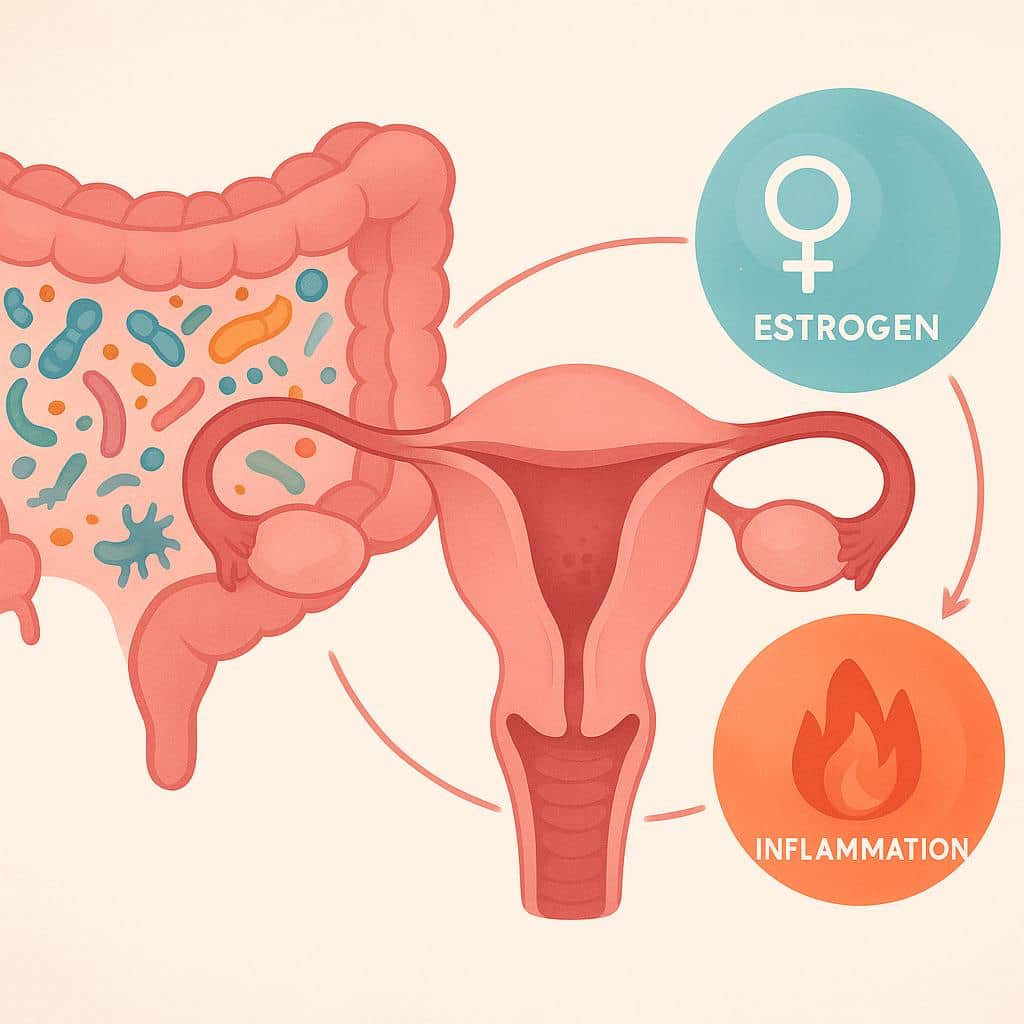
The gut microbiome is a key regulator of estrogen levels and influences estrogen metabolism, thereby potentially impacting estrogen-dependent conditions such as endometriosis.3 In postmenopausal women, both fecal microbiota richness and the abundance of fecal Clostridia taxa have been linked to systemic estrogen levels. Gut dysbiosis that results in abnormal circulating estrogen may therefore contribute to the development of endometriosis or to its associated symptoms.3
The Microbiome as a Diagnostic and Therapeutic Target
Altered microbiota composition in endometriosis may yield clinically useful biomarkers. One study proposed a microbiota-based model capable of distinguishing infertile patients with and without endometriosis.1 Another reported enrichment of specific bacterial species in the endometrium and peritoneal fluid of patients with the disease.2
On the therapeutic front, modulation of the gut microbiota—through dietary strategies, prebiotics, probiotics, or fecal microbiota transplantation—has been proposed as a potential treatment avenue.4 Further research is needed to clarify mechanisms and evaluate the efficacy and safety of such approaches in endometriosis management.
Conclusion
The relationship between the microbiome and endometriosis remains an active and evolving area of study. Current findings suggest that microbiota alterations may be associated with the condition, offering new insights into pathogenesis and pointing toward innovative diagnostic and therapeutic strategies. As research into the microbiome advances, so too does the promise of integrative health approaches that consider the complex ecosystem of microbes within and around us. Continued investigation is essential to confirm observed associations, elucidate underlying mechanisms, and determine whether microbiota changes in those with endometriosis are a cause, a consequence, or both. While there are limitations in the current usefulness of this research, we do know that the immune system is involved with regulating the disease. An important question remains: are the microbiota changes seen in those with endo the chicken or the egg?
References
Leonardi, M. Hicks, C. El-Assaad, F. El-Omar, E. & Condous, G. (2020). Endometriosis and the microbiome: a systematic review. _BJOG_, _127_(2), 239-249. DOI: 10.1186/s12905-025-04195-z
Oishi, S., Mekaru, K., Tanaka, S. E., Arai, W., Ashikawa, K., Sakuraba, Y., Nishioka, M., Nakamura, R., Miyagi, M., Akamine, K., & Aoki, Y. (2022). Microbiome analysis in women with endometriosis: Does a microbiome exist in peritoneal fluid and ovarian cystic fluid? _Reprod Med Biol_, _21_(1), e12441. https://doi.org/10.1002/rmb2.12441
Svensson, A. Brunkwall, L. Roth, B. Orho-Melander, M. & Ohlsson, B. (2021). Associations Between Endometriosis and Gut Microbiota. _Reprod Sci_, _28_(8), 2367-2377. DOI: 10.1093/biolre/ioaf272
Jiang, I. Yong, P. J. Allaire, C. & Bedaiwy, M. A. (2021). Intricate Connections between the Microbiota and Endometriosis. _Int J Mol Sci_, _22_(11). DOI: 10.1097/GCO.0000000000001041
Lee, S. R. Lee, J. C. Kim, S. H. Oh, Y. S. Chae, H. D. Seo, H. Kang, C. S. & Shin, T. S. (2021). Altered Composition of Microbiota in Women with Ovarian Endometrioma: Microbiome Analyses of Extracellular Vesicles in the Peritoneal Fluid. _Int J Mol Sci_, _22_(9). DOI: 10.3390/ijms22094608
Wei, W. Zhang, X. Tang, H. Zeng, L. & Wu, R. (2020). Microbiota composition and distribution along the female reproductive tract of women with endometriosis. _Ann Clin Microbiol Antimicrob_, _19_(1), 15. DOI: 10.1186/s12941-020-00356-0
Burns, K. A., Pearson, A. M., Slack, J. L., Por, E. D., Scribner, A. N., Eti, N. A., & Burney, R. O. (2021). Endometriosis in the Mouse: Challenges and Progress Toward a ‘Best Fit’ Murine Model. _Front Physiol_, _12_, 806574\. https://doi.org/10.3389/fphys.2021.806574
Quick Answers
Is an “endometriosis diet” evidence-based?
Yes and no. The evidence supports the idea that nutrition can influence pathways that matter in endometriosis (such as inflammation, oxidative stress, hormone metabolism, and the microbiome), so diet can be a meaningful part of symptom support. What the research does not support, at least not yet, is a single, universally proven “endometriosis diet” that reliably treats the disease or works the same way for everyone.
Most of the strongest signals come from observational research, where higher overall diet quality and Mediterranean-style, anti-inflammatory patterns are associated with better reproductive health and a lower likelihood of having endometriosis. That’s encouraging, but it isn’t proof that changing your diet will prevent endometriosis, shrink lesions, or predictably improve pain or fertility for an individual. In our experience, nutrition tends to be most helpful when it’s tailored to your symptom pattern, especially if you have significant bloating, bowel symptoms, or IBS overlap.
If you’re deciding what’s worth your time, we recommend focusing on evidence-aligned, sustainable changes rather than long lists of forbidden foods or internet protocols that promise a cure. Our team integrates nutrition and lifestyle strategies into an overall endometriosis plan, so you’re not left experimenting endlessly and can evaluate what’s actually helping you.
Can foods worsen endometriosis symptoms?
Yes, certain foods can make endometriosis symptoms feel worse for some people, even though there isn’t one universal endometriosis diet. Endometriosis is a chronic inflammatory condition, and eating patterns that increase inflammation (or trigger gut symptoms) can amplify pain, bloating, and fatigue. We also see that food sensitivities and overlapping GI symptoms, like IBS-type symptoms, can make endometriosis flares feel more intense, even if the underlying lesions are unchanged.
Rather than assuming you need to cut out a long list of foods, we usually recommend looking for your patterns. Keeping a simple symptom-and-food log for a few weeks can help identify whether certain meals correlate with pelvic pain, bowel symptoms, or a flare around your cycle. Many patients do best focusing on overall diet quality (think anti-inflammatory, Mediterranean-style eating) while avoiding extremes and internet forbidden foods lists. If you’d like a structured, evidence-informed approach, our team can help you integrate nutrition and lifestyle strategies into a plan that also addresses the disease itself, not just symptom management.
Can endometriosis make weight loss harder?
Yes, endometriosis can make weight loss feel harder, even though it isn’t proven to directly cause fat gain in a simple, one-to-one way. Many patients deal with endo belly (cyclical abdominal bloating), constipation or GI distension, fluid shifts, and inflammation that can make the scale and your waistline look worse without reflecting true fat gain. Pelvic pain, fatigue, and sleep disruption can also reduce activity and change appetite or stress patterns, which can indirectly affect weight over time.
There’s also emerging research suggesting some people with endometriosis may show more metabolic risk markers (like central waist measures and lipid patterns), but most data can’t prove cause and effect yet. In our experience, the key is separating bloating/inflammation from actual changes in body composition, then addressing the drivers that are modifiable for you. If weight loss has felt unusually difficult alongside pelvic pain, heavy periods, bowel/bladder symptoms, or a swollen abdomen that comes and goes, explore our educational resources and reach out to schedule a consultation so our team can help you map symptoms to a personalized plan, including evaluating whether excision surgery and integrative support could reduce the underlying burden.
What diet changes may support fertility with endometriosis?
There isn’t one proven endometriosis fertility diet, but research most consistently points to the importance of overall diet quality, especially Mediterranean-style, anti-inflammatory patterns. In practical terms, that usually means emphasizing minimally processed foods, plenty of plants, fiber, and healthy fats, while cutting back on dietary patterns linked with higher inflammation (often those heavy in ultra-processed foods and certain fats).
Specific nutrition areas we often discuss in a fertility-focused endometriosis plan include omega-3 intake (from food first when possible), steady fiber for gut and estrogen metabolism, and support for the microbiome, because gut and immune signaling may influence the hormonal and inflammatory environment around ovulation and implantation. Diet changes won’t erase endometriosis, but they can be a meaningful tool in a broader strategy that also considers the anatomy of the tubes and ovaries, inflammation, and timing. If you’d like, our team can help you choose evidence-aligned nutrition targets based on your symptoms, labs, and fertility goals, and integrate them with a plan for endometriosis treatment.
Is CA-125 helpful for fertility planning in endometriosis?
CA-125 is not a reliable tool for fertility planning in endometriosis. It’s a nonspecific inflammation marker that can be elevated with endometriosis, but it doesn’t consistently reflect disease subtype, lesion location, or the biologic factors that influence egg quality, tubal function, or implantation. For many patients, a normal CA-125 doesn’t rule out meaningful endometriosis, and a high value doesn’t tell us what your next fertility step should be.
When fertility is the goal, we focus on information that directly guides decisions: your full symptom history and flare pattern, expert imaging when appropriate, and ovarian reserve and ovarian-specific data (often including AMH and ultrasound follicle counts, especially if endometriomas are present). We also consider common overlapping issues that can complicate fertility, because endometriosis-related infertility often involves more than anatomy. If you’d like, our team can help you build a personalized evaluation plan so you’re not chasing one lab value that can’t answer your real question.